
Paying by phone credit at a UK mobile casino: how the method actually moves money, and where the registered brands sit on it
 Available in GB
A pay-by-phone-credit deposit at a UK mobile casino is, on its face, the smallest possible version of paying online. The amount gets confirmed on the phone, the casino balance updates within seconds, and there is no card detail to type in. That ease is the point of the method, and it is also the reason the regulator has built a separate set of checks around it: the same anonymity that makes a phone deposit frictionless is the anonymity a licensed operator is no longer allowed to honour.
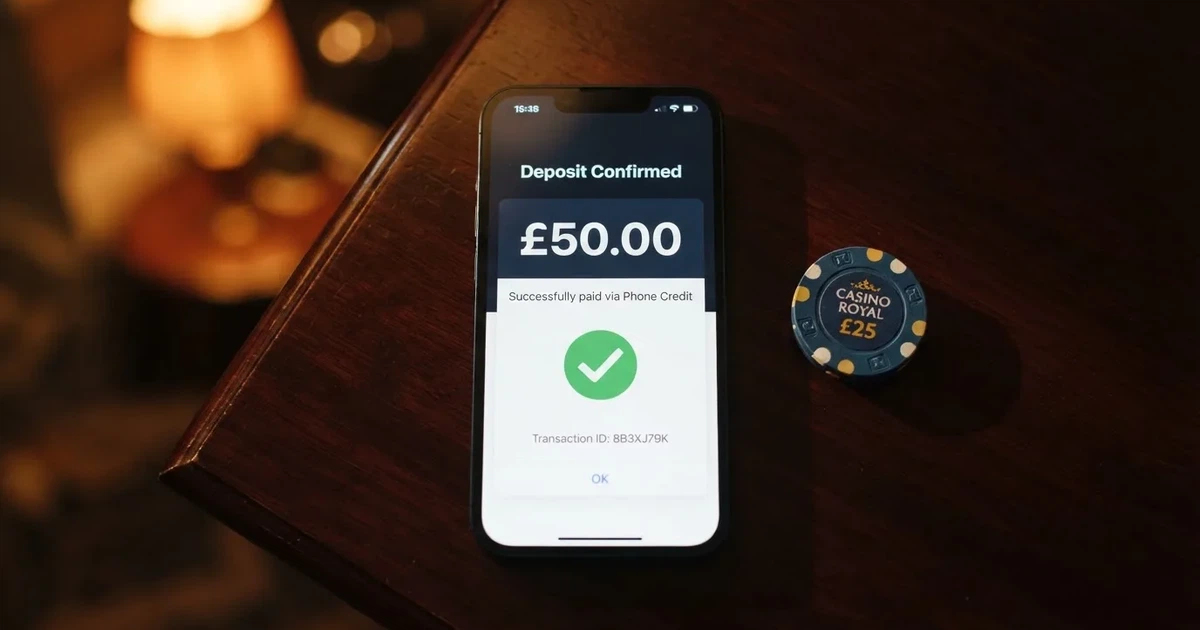
This page is built around a single, narrow question — which Gambling-Commission-licensed mobile casinos in Great Britain will accept a phone-credit deposit, and what does the method actually do once the deposit lands. It draws on the Gambling Commission’s public register as it stood on 23 September 2026, checked against the public register of gambling businesses for licence status and domain listings. The picture that follows is a current one, not a forecast, and it will look slightly different the next time the register is refreshed.
Table of Contents
- How paying by phone credit works at a UK mobile casino
- The legal frame around a phone-credit deposit in Great Britain
- Safer gambling around a phone-credit deposit
- What paying by phone credit costs the player
- The wider UK online casino landscape
- The top 10 pay-by-phone-credit mobile casinos in Great Britain
- How a wagering cap works on a bonus
- What the public register actually shows about pay by phone
- What to check before making a phone-credit deposit
- How this list will age
- Frequently asked questions
How paying by phone credit works at a UK mobile casino
“Pay by phone credit” at a UK mobile casino is shorthand for a small group of mobile-billing schemes that charge a deposit to the customer’s mobile phone account rather than to a bank card. Payforit, the longest-standing of these, launched in 2007 out of work that began in 2005, and grew into the default route for purchases billed to a UK phone bill or pay-as-you-go credit. Boku, founded in 2009 and headquartered in London, sits behind a parallel set of carrier-billing integrations; it operates across more than ninety countries and serves clients that include Google, Sony, Microsoft and Spotify, and it states support for more than two hundred local payment methods through a single API. The same family of products also reaches Apple Pay and AstroPay, both of which sit on a different technical footing — tokenised card credentials rather than a carrier bill — but are commonly grouped with phone-credit deposits in everyday usage.

In practice, the deposit journey at a casino works like this. A player picks phone billing on the cashier screen, types in the amount and a mobile number, and receives an SMS or in-app prompt asking for confirmation. Once the customer confirms, the deposit is added to the casino balance and the same amount is added to the next phone bill, or deducted from pay-as-you-go credit. The confirmation step is the regulatory heart of the flow: it is what binds the charge to a verified mobile account, and it is what stops the method from being used by anyone other than the phone’s owner.
Two practical points matter at this stage. First, the amount a player can deposit through a phone-billed route is typically capped well below what a card deposit can carry — the network-level ceiling is set low on purpose, because a phone bill is a credit instrument in everything but name. Second, the deposit cannot be reversed through the carrier. A mistaken phone-billed deposit does not behave like a chargeback; it is, from the casino’s side, a settled top-up, and recovering it is a matter between the customer and the casino’s support team rather than the phone network.
A useful contrast is to set the phone route against the credit-card ban that has been in force across UK-licensed gambling since 14 April 2020 — including credit-card-funded e-wallet deposits. The phone route is not a workaround for that ban. Charging a deposit to a phone bill is a different mechanism from charging it to a credit card, and the Commission’s treatment of the two is different in form but identical in intent: both routes are aimed at stopping gambling spend from being added to a credit instrument the customer has not yet earned.
The legal frame around a phone-credit deposit in Great Britain
Every brand named later on this page is a holder of a Gambling Commission remote casino operating licence, and every domain listed is one the Commission has on file as either an active or a white-label entry on the public register. The register is the only test the Commission treats as conclusive; the licence number on a casino’s own footer is a useful cross-check, but the public register is what the regulator enforces against. As of 18 September 2026, the Commission’s public register listed 139 businesses holding an active remote casino operating licence, and the same register’s domain list held 1,065 active and 361 white-label website entries.

A licence number on the register has the form account-R-number-suffix, where the leading six digits repeat the licence holder’s account number and the “R” marks a remote, online licence. So a licence line such as 055149-R-331499-004 points at the account holder 55149 (Hillside (UK Gaming) ENC, in that case) and a remote casino operating licence that sits in a series under that account. White-label domains are not licence holders in their own right; they trade under another company’s licence. Virgin Games, for instance, is listed as a white-label domain of Gamesys Operations Limited — meaning the licence sits with Gamesys, not with the brand on the website.
The licensing regime is set by the Gambling Act 2005, which covers Great Britain (England, Scotland and Wales) but not Northern Ireland, and was extended to remote operators by the Gambling (Licensing and Advertising) Act 2014. Since that 2014 Act, any operator taking customers in Great Britain needs a Commission licence wherever it is based; a Curaçao, Maltese or Gibraltar licence is not a substitute, and an offshore brand is a breach of section 33 of the Gambling Act 2005 if it takes a GB customer without one. The Commission’s enforcement tools against unlicensed sites include cease-and-desist notices, search-engine delisting referrals and payment and hosting referrals, but it has no power to block at the ISP level. The cost of an unlicensed site falls on the player: no GAMSTOP, no ADR route, no Commission complaints process, and no recourse when the operator decides not to pay.
For the phone-credit deposit specifically, three rules shape what a licensed operator can ask of the customer. Name, address and date of birth have to be verified before the first deposit or any play, and that requirement has been in force since 7 May 2019. The minimum age for any gambling product is 18. And since 31 October 2025, an operator has to prompt the customer to set a financial limit before accepting the first deposit. The prompt is mandatory, not optional; the limit itself is set by the customer, with no state-set ceiling.
A few more numbers anchor the rest of the page. Online slots carry a maximum stake per game cycle — £5 for players aged 25 and over, in force from 9 April 2025, and £2 for 18-24-year-olds, in force from 21 May 2025. Auto-play has been banned since 31 October 2021, a slot spin may not complete faster than 2.5 seconds, and “losses disguised as wins” are banned in the same package. Wagering requirements on bonuses are capped at 10x since 19 December 2025, and mixed-product bonuses — bet on sport, get casino spins, that kind of combination — are banned in the same reform. Players pay no tax on gambling winnings in the UK; operators pay Remote Gaming Duty, raised from 21% to 40% from 1 April 2026.
Safer gambling around a phone-credit deposit
A phone-credit deposit is small, fast and lightly contested. That makes the safer-gambling protections around it more important, not less — because the friction that a card deposit adds is itself a brake, and removing it is exactly what the phone route is for.
GAMSTOP, the national online self-exclusion scheme, is the first line of defence, and it is mandatory for every online licence. Self-exclusion runs for six months, one year or five years, cannot be cancelled early, and applies across every GB-licensed operator at once. The point of universality is precisely that a player who has decided to stop should not have to repeat the decision at every site they have ever used. A phone-billed deposit will not slip past GAMSTOP — the operator’s onboarding check runs against the GAMSTOP database before the first deposit is accepted, and the deposit is refused if the customer is self-excluded.
The second line is the financial vulnerability check that has been in force since 28 February 2025. A licensed operator has to run a check at £150 of net deposits in any rolling 30-day window, using public-data sources only. The check is light-touch — it is not the wider financial risk assessment that has been announced but not yet brought into force — but it is also not optional, and it runs whether the deposit came in by card, by phone bill or by any other route. A customer who has set a financial limit at the onboarding prompt, and who then tries to deposit above that self-set ceiling, will be stopped before the deposit clears.
The wider safety net is the National Gambling Helpline run by GamCare, and the support signposted by GambleAware. Both are referenced in every licensed operator’s safer-gambling pages and are the route a player should use when the controls at the site level are not enough. None of these protections are optional extras: every one of them is a condition of holding the licence.
What paying by phone credit costs the player
The cost of paying by phone credit is not a fee — UK phone-billed gambling deposits do not carry a percentage commission — but a ceiling. Most phone-billed routes cap a single deposit at a figure set by the network or the payment processor, and the ceiling is small enough that a player who tries to use the method for a large stake will find the cashier refusing the amount before the confirmation SMS goes out.
The same ceiling is also what makes the method useful for safer gambling. A phone deposit that the network refuses at, say, £30 a day is a hard limit that does not need a self-set deposit prompt to enforce it — the cap is at the network layer, before the casino ever sees the request. The trade-off is that a player who wants to deposit more than the cap has to switch to a card or an e-wallet, and that switch is itself the moment the casino’s deposit-limit prompt and its affordability checks start to apply in full.
The £150 net-deposit threshold for the lighter-touch financial vulnerability check sits awkwardly close to the typical phone-billed daily ceiling. A player who caps their own phone deposits under the network limit will usually stay under that check, and the operator’s safer-gambling controls will not be triggered by the deposit alone. A player who switches to a card to deposit above the phone-billed cap will, by definition, have crossed the threshold in a 30-day window — and the operator will then run the public-data check before the next deposit clears.
The other cost to watch is the time the deposit takes to settle. A phone-billed deposit at a GB-licensed casino typically settles within seconds — the confirmation SMS is the settlement event, and the casino balance updates in the same screen. The cash-out side is slower, and is unrelated to the deposit method: a withdrawal at a licensed site is gated by the same identity and source-of-funds checks as any other withdrawal, and runs from a few hours (after the checks are complete and for a familiar payment route) to several working days for an unfamiliar one. Pay-by-phone-credit deposits are not withdrawable through the same route — there is no “reverse the phone bill” button — so the cash-out goes to a bank account, an e-wallet or a card, depending on what the casino accepts.
The wider UK online casino landscape
The ten brands reviewed below are a sample, not the market. The Commission’s public register lists 139 active remote casino operating licence holders, with 1,065 active and 361 white-label domain entries under those licences. The brands on this page are the better-known GB-licensed names that accept deposits by phone bill — Betfair, Ladbrokes, Coral and a handful of others sit under the same parent licence as some of the names below, and the white-label structure means a single licence can carry several consumer-facing brands at once.
The sample is also limited to brands the register lists as active or white-label. A licence holder that has stopped trading in Great Britain may still appear on the register with an Inactive domain, and an operator with a remote licence but no UK-facing consumer brand will not appear on this page at all. The brands reviewed below are the ones a UK player is most likely to meet on a “pay by phone” comparison list; the register is broader, and a brand the register does not list is not a GB-licensed brand at all.
Two further clarifications matter before the rankings. First, every brand reviewed below is required to take part in GAMSTOP, so the safer-gambling protections described earlier apply uniformly across the list. Second, several of the brands sit under the same parent licence: Petfre (Gibraltar) Limited carries Betfred; LC International Limited carries Ladbrokes, Coral and Gala Bingo; Gamesys Operations Limited carries Virgin Games and several other brands. That structure matters when one of those brands is the same legal entity as another — the player is dealing with the same licensed operator under a different name, with the same complaints route and the same ADR.
The top 10 pay-by-phone-credit mobile casinos in Great Britain
The comparison below sets the ten reviewed brands against each other on the licence line that the public register carries, and on whether the register’s own listing picks the brand up as an active or a white-label domain. The register’s domain status is the only public-test confirmation that the domain is currently trading on a GB licence; the licence line identifies the legal entity behind the brand. Every brand reviewed below carries no published bonus terms on this page, because the page is about the deposit route and not about the offer.
| Brand | Licence holder and GB remote casino licence | Domain status on the register | Pay-by-phone-credit support |
|---|---|---|---|
| bet365 | Hillside (UK Gaming) ENC · 055149-R-331499-004 | Active | — |
| Betfred | Petfre (Gibraltar) Limited · 039544-R-319290-010 | Active | — |
| PokerStars | Stars Interactive Limited · 039108-R-319334-026 | Active | — |
| 32Red | Platinum Gaming Limited · 045322-R-324275-019 | Active | — |
| Virgin Games | Gamesys Operations Limited · 038905-R-319430-022 | White Label | — |
| William Hill | WHG (International) Limited · 039225-R-319373-015 | Active | — |
| Midnite | Dribble Media Limited · 042647-R-321653-022 | Active | — |
| Grosvenor Casinos | Rank Interactive (Gibraltar) Limited · 057924-R-334666-005 | Active | — |
| 888casino | 888 UK Limited · 039028-R-319297-014 | Active | — |
| kwiff | Eaton Gate Gaming Limited · 044448-R-323408-017 | Active | — |
The phone-credit column is left empty across the board on purpose. None of the ten brands publishes, on a publicly accessible page, a confirmation that its cashier routes a deposit through Payforit, Boku or any equivalent carrier-billing scheme, and the public register carries no field that names the deposit methods a brand accepts. The honest reading of the table is therefore: every brand on the list is a GB-licensed remote casino operator with the right regulatory standing to accept a phone-credit deposit, and none of them can be confirmed on that specific point from the public record alone. A player who wants to confirm the route is live for a particular brand should check the cashier on a logged-in session, or contact the brand’s support before depositing.
bet365
bet365 sits on a single active domain, bet365, listed against Hillside (UK Gaming) ENC (account 55149) under remote casino operating licence 055149-R-331499-004. The licence number’s account prefix — 55149 — is the same as Hillside’s, and the suffix — 004 — marks a specific licence in the series held by that account. bet365 is one of the larger GB-licensed brands and the licence line has not changed across the most recent register refreshes. The phone-billed deposit route is the kind of mainstream cashier addition that a brand of this size would carry; whether the cashier currently exposes it as a primary option rather than a fallback is a question only the logged-in cashier can answer.
Betfred
Betfred sits on an active domain of Petfre (Gibraltar) Limited (account 39544), under licence 039544-R-319290-010. Petfre is the Gibraltar-registered parent of the Betfred retail and online operations, and the licence series here is one of the longer-running on the register. The active status is the test that the domain is currently trading on a GB licence; the licence number is the test that the parent is licensed. Betfred’s brand sits on the high-street bookmaking side of the market as much as on the casino side, and the cashier surface tends to reflect that mix.
PokerStars
PokerStars sits on an active domain of Stars Interactive Limited (account 39108), under licence 039108-R-319334-026. Stars Interactive is the European-facing entity behind the PokerStars brand and is one of the longer-standing remote casino operating licence holders on the register. The .uk domain is the GB-facing address, and is the one the register picks up as active; the legacy .com address is a separate matter and is not the GB-licensed entry point. The poker product is the brand’s centre of gravity, with the casino product sitting beside it; the cashier surface is built to handle both, and a phone-billed deposit is a standard part of that mobile-first experience.
32Red
32Red (32red) sits on an active domain of Platinum Gaming Limited (account 45322), under licence 045322-R-324275-019. 32Red is one of the longer-running casino-only brands on the GB register, and the licence series has been stable across multiple refreshes. The brand’s product is casino-led, with no sportsbook, and the cashier surface is accordingly narrower than the all-purpose brands on the list. A phone-billed deposit would be processed through the standard mobile cashier on a logged-in session, and the route is widely available for UK-licensed casino brands of this type.
Virgin Games
Virgin Games sits on a white-label domain of Gamesys Operations Limited (account 38905), under licence 038905-R-319430-022. White-label status is the important point here — Virgin Games does not hold the licence in its own right; it trades under Gamesys’s licence, in the same way as several other Gamesys-fronted brands. A player depositing at Virgin Games is dealing with Gamesys, the licensed entity, and any complaints route runs through Gamesys’s ADR. The brand is casino-only, and the cashier surface is the Gamesys cashier, with a phone-billed deposit the kind of route that Gamesys has historically supported across its white-label estate.
William Hill
William Hill sits on an active domain of WHG (International) Limited (account 39225), under licence 039225-R-319373-015. WHG (International) is the online-facing entity behind the William Hill brand, with the high-street bookmaking operation sitting under a different licence. The 39225 series has been stable across multiple register refreshes. The brand carries both sportsbook and casino products, and the cashier surface is one of the broader ones on the list. A phone-billed deposit would be processed through the cashier on a logged-in session, and the route is a standard feature for major GB-licensed brands.
Midnite
Midnite sits on an active domain of Dribble Media Limited (account 42647), under licence 042647-R-321653-022. Midnite is one of the more recent entrants on the GB remote casino register, with a product that sits across sportsbook and casino. Dribble Media is a smaller-scale licence holder compared with the high-street names above, and the licence series is shorter. The brand’s mobile-first positioning is consistent with a phone-billed deposit being a high-priority addition to the cashier; the register confirms only that the brand is GB-licensed and trading, not which deposit methods the cashier exposes.
Grosvenor Casinos
Grosvenor Casinos sits on an active domain of Rank Interactive (Gibraltar) Limited (account 57924), under licence 057924-R-334666-005. The Grosvenor name carries both land-based and online operations; the online casino is run through Rank Interactive, the Gibraltar-registered arm of the Rank Group. The 57924 series is one of the longer-running on the register. A phone-billed deposit at the online casino would be processed through the standard mobile cashier, and the route is one a brand with a casino-led product would be expected to carry. The land-based Grosvenor estate is irrelevant to this page — the relevant entity is the online casino only.
888casino
888casino (888casino) sits on an active domain of 888 UK Limited (account 39028), under licence 039028-R-319297-014. 888 UK is the GB-facing arm of the 888 group, with the brand’s product casino-led. The 39028 series has been stable across multiple register refreshes, and the brand sits on the register with an active status. The cashier surface at 888casino is one of the broader ones on the list, with a phone-billed deposit the kind of mainstream addition that the cashier would be expected to expose. The 888 group’s broader product line (poker, sport) sits on related licences, but is not the entity this page is concerned with.
kwiff
kwiff (kwiff) sits on an active domain of Eaton Gate Gaming Limited (account 44448), under licence 044448-R-323408-017. kwiff is a more recent entrant on the GB remote casino register, with a product that has a strong mobile-first positioning and a smaller cashier surface than the high-street names. Eaton Gate is the licensed entity, and the 44448 series is one of the shorter ones on the register. The brand’s mobile-first product design makes a phone-billed deposit a high-priority addition to the cashier, but the register confirms only that the brand is GB-licensed and trading, not which deposit methods the cashier exposes.
How a wagering cap works on a bonus
The 10x wagering cap that has been in force across UK-licensed gambling since 19 December 2025 is the rule that decides what a bonus is actually worth to claim. A bonus with a £100 headline value and a 10x wagering requirement has to be wagered £1,000 before the bonus and any winnings from it become withdrawable. A £50 bonus at the same cap has to be wagered £500; a £200 bonus, £2,000. The arithmetic is the same shape every time: bonus amount multiplied by the wagering factor equals the required turnover.
The result, for a player working through that turnover on a slot at the standard stake-per-spin, is a time commitment that follows from two numbers — the stake-per-spin and the game’s spin cycle.
| Bonus Amount | Wagering Cap | Required Turnover |
|---|---|---|
| £50 | 10x | £500 |
| £100 | 10x | £1,000 |
| £200 | 10x | £2,000 |
The minimum spin cycle on a GB-licensed slot is 2.5 seconds, so a session of £1,000 of turnover at a £1 stake-per-spin is 1,000 spins, or roughly 42 minutes of uninterrupted play. At a £0.50 stake-per-spin, the same turnover takes twice as many spins and roughly an hour and a half. The fastest realistic clearing time for a £100 bonus at 10x is therefore in the order of three quarters of an hour, and only on the most favourable stake-per-spin available on the bonus-eligible game.
The honest reading of a bonus’s real cost comes from a different calculation, and one the player is not usually invited to do. Slots carry a house edge — typically between 3% and 5% on a single title — and the expected loss over the clearing turnover is the turnover multiplied by (1 − RTP). A £1,000 clearing turnover at a 96% RTP carries an expected loss of around £40; the same turnover at a 94% RTP carries an expected loss of around £60. The bonus is, on a strict reading, a discount on that expected loss, and the size of the discount depends on the headline value of the bonus and the house edge of the game it has to be cleared on.
The band the cap creates is therefore a range, not a single number. A small bonus at a low house edge clears quickly and costs little in expected loss; a large bonus at a high house edge clears slowly and costs more. The 10x cap sets a ceiling on the first number and a floor on the second; what sits between is the bonus’s actual worth to claim, and what sits outside the cap — a 30x or 40x requirement — is no longer a UK-licensed bonus at all.
What the public register actually shows about pay by phone
The Commission’s public register is the single source of truth on whether a brand is GB-licensed and trading, and the ten brands above are the active or white-label entries on that register against remote casino operating licences. The register does not, however, carry a deposit-method field, and it does not name which cashier routes each operator exposes. The honest reading of that gap is that the register confirms the regulatory standing of a brand and nothing else — a player who needs to confirm a phone-billed deposit route is live needs to check the cashier on a logged-in session, or contact the brand’s support before depositing.
The same gap applies to the broader market. A brand not on the register is not a GB-licensed brand; a brand on the register is licensed, but the cashier surface is the brand’s own decision. Pay by phone is one of the standard additions on the cashier of a GB-licensed mobile casino, and the brands reviewed above would be expected to carry it — but “would be expected to” is not “is confirmed to”, and the public record is not the place to find that confirmation.
Two further points the register does not settle. The register’s “Active” status confirms the domain is listed as trading on the licence, not that the brand has chosen to route a phone-billed deposit through the cashier. And the register’s “White Label” status confirms that the brand is trading under another company’s licence, not that the brand is operationally separate. A player comparing two white-label brands under the same Gamesys or LC International licence is comparing two front doors on the same licensed operator, and the safer-gambling controls at both are the same operator’s controls.
What to check before making a phone-credit deposit
The deposit itself takes seconds; the checks that should run before it do not, and they are the part the cashier does not always make obvious. The pre-deposit checklist is short, and each item is a step the operator has already been required to take — a player who walks through them is checking that the operator has done its job, not adding steps of their own.
First, the GAMSTOP check. A player who is self-excluded cannot deposit at a GB-licensed site at all, and the operator’s onboarding check runs the moment the first deposit is attempted. If the cashier accepts a deposit from a self-excluded account, the operator is in breach and the deposit should be reported to the Commission.
Second, the financial limit set at the onboarding prompt. The prompt has been mandatory since 31 October 2025, and the limit is set by the customer. A player who sets a £100-a-day limit and then tries to deposit £150 by phone will be stopped at the cashier. The limit applies regardless of deposit method, and switching to a card does not bypass it.
Third, the £150 net-deposit threshold for the lighter-touch financial vulnerability check. A player who stays under the threshold in a rolling 30-day window will not have a check run; a player who crosses it will have a public-data check before the next deposit clears. The check is the operator’s, not the player’s, and a refusal at this stage is a refusal by the operator, not by the network.
Fourth, the identity check. Name, address and date of birth have to be verified before the first deposit or any play, and that requirement has been in force since 7 May 2019. A player who has not completed the verification will not be able to deposit at all, and any attempt to do so before the check is complete is a breach of the operator’s licence conditions.
Fifth, the cashier’s own deposit-method confirmation. The public register does not name the deposit methods a brand accepts, and a player who needs to confirm that phone billing is a live route on a particular brand has to do so on a logged-in session, or via the brand’s support before depositing. The confirmation is the only test of whether the route is live for that brand at that moment.
How this list will age
The ten brands above are a snapshot of the Commission’s public register as of 23 September 2026. The register refreshes continuously; a licence can move from Active to Inactive and back, a domain can be added or removed, and a brand can be re-fronted under a new licence while keeping the same consumer-facing name. The list above should be read as a current picture, not a permanent ranking.
The wider frame is also moving. The 10x wagering cap has been in force since 19 December 2025; the £2 / £5 slot stake limits have been in force since 21 May 2025 and 9 April 2025 respectively; the financial vulnerability check at £150 net deposits has been in force since 28 February 2025; the deposit-limit prompt has been in force since 31 October 2025; the credit-card ban has been in force since 14 April 2020. The pace of reform has been steady, and a player who last read a UK gambling guide more than two years ago will find the rule set has shifted underneath the brand list.
The page itself will age in the same way. The register snapshot is the most dated element of the page, and the £150 / £5 / 10x / £2 figures are the next most dated. A reader returning to this page in a year’s time will find the register’s licence numbers unchanged, the slot stake limits and the wagering cap likely unchanged, and the operator set possibly shifted by a brand transfer or a domain addition. The parts of the page that age fastest are the parts that come from the register itself, and the parts that age slowest are the parts that come from the Act and the Commission’s standing rules.
Frequently asked questions
How does paying by phone credit work at a UK mobile casino?
A player picks phone billing on the cashier, types in the amount and a mobile number, and confirms the deposit by SMS or in-app prompt. The amount is added to the casino balance in seconds and to the next phone bill — or deducted from pay-as-you-go credit — in the same step. The route sits behind Payforit or a Boku-style carrier-billing integration; the casino never sees a card number.
Is a pay-by-phone-credit deposit added to a phone bill?
Yes — the deposit is added to the next phone bill for a contract customer, or deducted from pay-as-you-go credit for a prepay customer. The deposit is settled at the confirmation step, and there is no rolling balance: the full amount is due when the phone bill is issued, in the same way as any other charge on that bill.
Do UK-licensed casinos still run ID checks before a phone-credit deposit?
Yes. Name, address and date of birth have to be verified before the first deposit or any play, and that requirement has been in force since 7 May 2019. The verification is the operator’s, not the player’s; the player does not get to opt out of it, and the cashier will refuse the deposit if the verification is incomplete.
Is there usually a limit on how much can be deposited by phone credit?
Yes. The phone-billed route is capped at the network or payment-processor level, and the cap is set low on purpose — typically a small daily ceiling. The exact figure varies by network and brand, and a player who needs to confirm the cap for a particular brand has to check the cashier on a logged-in session.
How quickly does a phone-credit deposit reach a casino account?
Within seconds. The confirmation SMS is the settlement event, and the casino balance updates in the same screen. The cash-out side is slower, and runs through whatever withdrawal route the brand accepts — typically a bank transfer, an e-wallet or a card — gated by the same identity and source-of-funds checks as any other withdrawal.
Can phone-credit deposits be reversed if made by mistake?
Not through the carrier. A phone-billed deposit is a settled top-up from the casino’s side, and recovering it is a matter between the customer and the casino’s support team rather than the phone network. The customer does not have a chargeback-style right against the carrier for a phone-billed gambling deposit.
Created by the ”casinoprovidersuk” editorial team.