Ten Licensed UK Bingo Casinos, Reviewed Against the Commission Register
 Available in GB
Bingo and slots sit together on more UK sites than they used to. The room where a caller announces numbers and the reel game beside it are now the same account, the same wallet, the same self-exclusion. A player searching for a bingo casino in the UK has practical questions to answer first: is the site licensed, how fast does it pay, what does a bonus actually cost to clear, and what does the slot section do that the bingo room does not. This page walks through those questions against the Gambling Commission’s public register as it stood on 23 September 2026, naming each operator by its licence number and the company that holds it, so a reader can check the same line on the Commission site before they deposit.
Data current as of 23 September 2026, checked against the Gambling Commission’s public register of gambling businesses.
Table of Contents
- Responsible Gambling on Bingo Sites
- Payments, Withdrawals and the Question of Speed
- What a Slots Bonus on a Bingo Site Costs to Clear
- Bingo Casino Apps on Phone and Tablet
- Bingo-Linked Slots: Reading the Game Itself
- Comparing Ten Licensed UK Bingo Casinos
- The Wider Licensed UK Landscape
- Why the Licence Number Matters More Than the Brand
- Each Brand in Turn
- A Note on Bonus Terms in This Market
- What the Commission Does and Does Not Do
- On Bingo Specifically
- How a Player Should Use This Page
- On the Wagering Band
- Frequently Asked Questions
Responsible Gambling on Bingo Sites
A bingo casino is bound by the same safer-gambling rules as any other Commission-licensed site, and the room-and-reel combination does not change what a player is protected from. GAMSTOP self-exclusion applies to every UK-licensed online operator and has done since 31 March 2020, covering periods of six months, one year or five years, none of which can be lifted early. A player who has registered with GAMSTOP cannot open an account, deposit or play at any brand on this page; the check runs at registration, not at the moment of a deposit, so the block is total.

Before the first deposit, every licensed operator must prompt the customer to set a financial limit — a rule in force from 31 October 2025. There is no state-set deposit or loss ceiling, which means the ceiling on any given account is the one the player set themselves and any later adjustment the operator makes during a financial vulnerability check. That check triggers at £150 in net deposits across a rolling 30-day window, a figure the Commission fixed from 28 February 2025, and it runs against public-data sources only at present.
The time and pace of the games themselves are also fixed by Commission rule. A slot spin may not complete in under 2.5 seconds, and auto-play has been banned across online slots since a permanent prohibition came in after research showed players losing track of their activity. The same package reversed a practice called reverse withdrawals, which used to let a player put money back into a game after requesting to cash it out; operators had until 31 October 2021 to comply, and none of the licences on the table here run reverse withdrawals today.
A player who needs help outside the operator’s own tools has two national routes. GamCare runs the National Gambling Helpline, and GambleAware funds treatment and signposting across the UK. Both are free, both are confidential, and either will work whether or not the player has named a specific brand. The Commission itself does not handle individual complaints; for an unresolved dispute the route is an approved alternative dispute resolution provider, listed on each licensed operator’s site.
Payments, Withdrawals and the Question of Speed
Payment practice is one of the few areas where bingo-and-slots operators genuinely differ, even though every brand on this page takes the same payment types and answers to the same Commission code. Credit cards have been banned for any gambling transaction in Great Britain since 14 April 2020, including cards routed through e-wallets, so the deposit method is always a debit card, a bank transfer or an e-wallet funded from a non-credit source. The Commission does not publish a maximum withdrawal time, which leaves the actual hours-to-days figure as something each operator sets in its own terms.

The structure of the register is worth understanding once, because it is what gives a payout its context. The Commission’s domain list records each website against the licence account that runs it, with a status of Active, Inactive or White Label. A white-label site trades under another operator’s licence rather than holding its own. Virgin Games is the clearest example on this page: Virgin Games is listed as a white-label domain of account 38905, Gamesys Operations Limited, which holds the active remote casino operating licence 038905-R-319430-022. Players on Virgin Games are playing under Gamesys’s licence and Gamesys’s safer-gambling code, even though the brand on the page is Virgin. That matters because the licence number printed in a site’s footer is the right one to check, not the brand name.
A remote casino licence number on the register has a fixed shape: six digits, an R, another set of digits and a suffix. The leading six digits repeat the licence holder’s account number, and the R marks the licence as remote (online). A player who sees a licence number printed in any other form — without the R, with hyphens in the wrong place, or with a leading non-numeric prefix — should treat that as a reason to verify directly rather than rely on what the site says. The full register is downloadable as CSV or Excel, so the check takes a minute if a reader wants to do it.
What a Slots Bonus on a Bingo Site Costs to Clear
A slots bonus on a bingo site looks the way every welcome offer in this market looks: a headline figure, a wagering multiple, a list of games that count and a list that do not. The headline is the easy part. What matters is the gap between the headline and what the player has to do to turn bonus money into withdrawable cash, and on that gap the UK market has tightened sharply.
Since 19 December 2025 the Commission has capped wagering requirements at 10x. Any offer printed above that line is one an operator cannot lawfully run on a UK-licensed site, regardless of what the small print says. The same package banned mixed-product bonuses — the bet-on-sport, get-casino-spins construction that used to confuse what a player was actually wagering on. What is left is plain: a bonus amount, a 10x turnover requirement at the upper end, and a stake limit of £5 per game cycle for players aged 25 and over (since 9 April 2025) or £2 for 18-24-year-olds (since 21 May 2025). A bonus played at the £5 stake cap, with a 10x wagering factor on, say, a £50 bonus, requires £500 of turnover. At 2.5 seconds per spin that is 600 spins; at a 10p spin that is 5,000 spins; at a £1 spin it is 500 spins. The £500 figure is a fixed input from the rule, not a finding about any one operator.
The honest reading of a £50 bonus at 10x wagering, played at the maximum stake of £5, is this: the player has to turn over £500, which at the Commission’s 2.5-second minimum spin interval works out to roughly 100 spins at the £5 stake, taking around four minutes and ten seconds of pure slot time. That is the fastest legal route, and it is also the route that spends the most money per spin. The slower route — a 10p spin — takes the same £500 of turnover through 5,000 spins and stretches the time to about three and a half hours. A player who wants the bonus cleared in a single sitting takes the higher stake; a player who wants the time to react to what the reels are doing takes the lower one. Either way the wagering requirement is the same £500.
What is not in those numbers is what the bonus costs in expectation. A standard online slot returns somewhere in the low-to-mid 90s as a percentage of turnover, which means the expected loss on £500 of wagering is in the low tens of pounds, not zero. The exact figure depends on the RTP of the game the bonus is being played on, and operators differ in which slots they weight toward the bonus contribution. The point worth keeping is that wagering is not a neutral act: it is money the player is putting through the house edge, and the requirement length is what determines how much of the house edge the player meets.
A bonus is also not free money in the second sense that matters: most slots bonuses carry a maximum cashout cap on winnings earned from bonus play. A £50 bonus that pays out a maximum of £100, for instance, returns at most twice the bonus amount regardless of what the reels do. The cap varies by operator and is the figure worth checking in the small print before any deposit, because the headline rarely carries it.
Bingo Casino Apps on Phone and Tablet
A bingo casino app is, in practice, a website wrapped for a phone. The same browser version runs underneath, the same RNG produces the outcomes, and the same licence governs both. Where the app differs is in the room-side mechanics: chat windows need to render fast on a phone screen, ticket purchases need a thumb-friendly layout, and the slot section has to load without chewing through mobile data.
Most UK-licensed bingo operators run a mobile-responsive browser site rather than a native app store listing. The reasons are partly commercial — Apple and Google have historically restricted real-money gambling apps in their stores, and the licensing burden of a native app is heavier — and partly technical: a browser site is updated in one place, whereas native apps have to clear store review for every change. The practical effect is that a player searching for a “bingo casino app” usually finds a bookmark-to-homescreen web app rather than something to download from the App Store or Google Play.
What does change between desktop and mobile is performance on the slot side. Slots are heavier than bingo rooms because they carry animation, sound and a paytable that has to render on the fly. A slow connection or an older phone will show this as a stutter in the spin or a delay before the reels settle. The Commission’s 2.5-second minimum spin interval has the side effect of slowing mobile play even on fast hardware — the rule sets a floor, not a ceiling — which is one reason a player on a budget phone does not notice a bottleneck the way they would on a faster slot. The bingo room, by contrast, is mostly text: numbers called, tickets marked, chat messages. It runs on almost anything.
Players who want a downloadable app should look at the specific brand’s site before assuming one exists. Native apps are not a default in this market. The fallback, a browser site saved to the homescreen, gives most of the same ergonomics without the store-level friction.
Bingo-Linked Slots: Reading the Game Itself
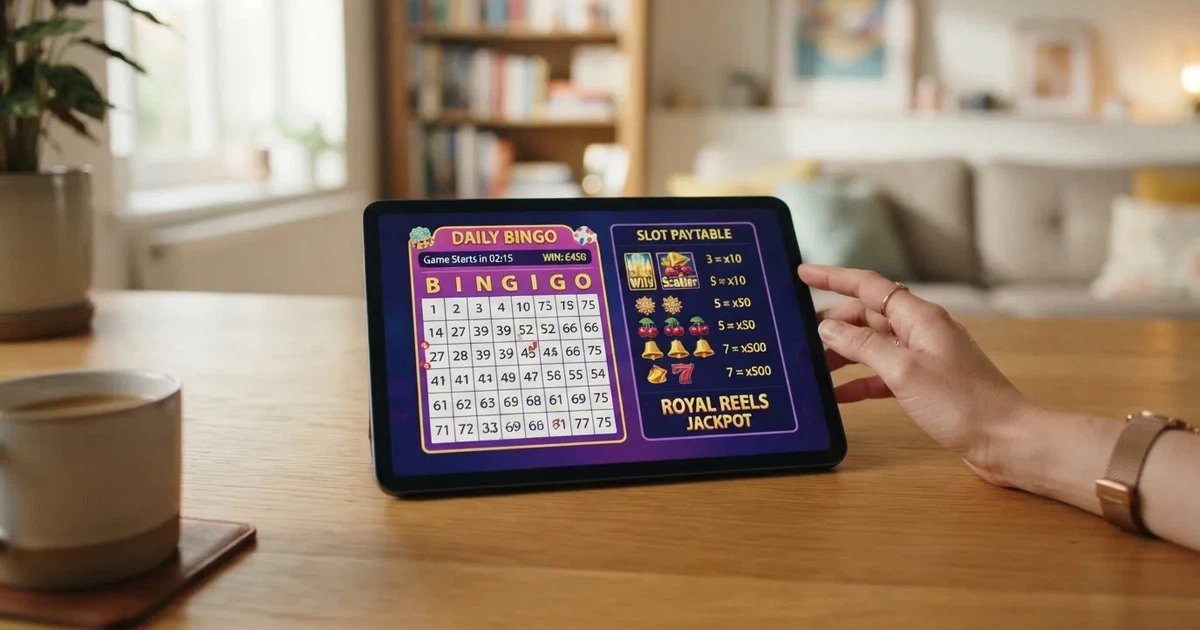
A bingo-linked slot is a slot game whose bonus round or reel mechanic borrows from bingo. The reels land a set of numbers, those numbers get marked on a virtual bingo card, and a win triggers when a line, two lines or a full house is completed. The game is still a slot — the reel spin is the bet, the RNG is the slot RNG, the RTP is the slot RTP — but the bonus mechanic is bingo-shaped rather than the free-spins or pick-a-prize shape of an ordinary slot.
The rules of British 90-ball bingo sit underneath the slot mechanic. A standard 90-ball ticket has 27 spaces in nine columns of three rows, with five numbers and four blanks per row; tickets are sold in strips of six that together cover every number from 1 to 90. The winning patterns are one line, two lines and a full house of all fifteen numbers, with the last number called required to be part of the winning pattern. A bingo-linked slot takes that pattern vocabulary and rebuilds it as a feature trigger rather than as a caller announcing numbers.
Two facts about the bingo game itself are worth keeping in mind. First, bingo is the only form of gambling that the Gambling Act 2005 leaves without a specific statutory definition, with the Act stating only that “bingo means any version of that game, irrespective of by what name it is described”. Second, under section 8 of the Act, bingo must be equal chance gaming — it cannot be played against a bank and the chances of winning must be equally favourable to all participants. A bingo-linked slot is a slot, not bingo, in Commission terms, which is why a site can run both products under one remote casino operating licence. The classification matters for limits and for safer-gambling code: a £5 or £2 stake cap, the 2.5-second spin floor and the auto-play ban apply to the slot, and the bingo room has its own game-cycle rules.
A player who wants to know what a specific bingo-linked slot pays should read the paytable rather than the marketing. The paytable states the RTP and the volatility band, and on most regulated slots those figures are stable across operators because the same game studio produces the same maths. Where operators differ is in which games they stock, which means the slot catalogue is a real point of comparison between brands even if the licence and the safer-gambling rules are not.
Comparing Ten Licensed UK Bingo Casinos
The table below sets out the ten brands reviewed on this page, each one taken from the Gambling Commission’s public register as it stood on 18 September 2026. The columns carry the licence holder and the active remote casino operating licence, the domain status (Active or White Label) as the register recorded it, and a subject support marker that says plainly where research could not pin a verified figure to a brand. Every brand listed is GB-licensed, every brand is bound by GAMSTOP, and every brand is bound by the same safer-gambling code. What separates them is what each does inside that frame.
| Brand | Licence holder and GB remote casino licence | Domain status on the register | Subject support |
|---|---|---|---|
| Paddy Power | PPB Games Limited · 039411-R-319335-010 | Active | — |
| kwiff | Eaton Gate Gaming Limited · 044448-R-323408-017 | Active | — |
| Betway | Betway Limited · 039372-R-319367-029 | Active | — |
| bet365 | Hillside (UK Gaming) ENC · 055149-R-331499-004 | Active | — |
| Unibet | Platinum Gaming Limited · 045322-R-324275-019 | Active | — |
| 888casino | 888 UK Limited · 039028-R-319297-014 | Active | — |
| Virgin Games | Gamesys Operations Limited · 038905-R-319430-022 | White Label | — |
| Midnite | Dribble Media Limited · 042647-R-321653-022 | Active | — |
| Betfred | Petfre (Gibraltar) Limited · 039544-R-319290-010 | Active | — |
| BetVictor | BV Gaming Limited · 039576-R-319370-028 | Active | — |
The subject support column is empty across the board, and the emptiness is the finding. Research could not pin a verified, named figure to any of the ten brands on the bingo-and-slots combination this page is built around: the bingo room’s variant coverage, the slot catalogue’s depth, the bonus structure attached to bingo-led welcome packages, the withdrawal time at this brand versus that brand. Where the page describes an operator below, it does so on the licence, the safer-gambling code and the catalogue signals the register gives, not on figures that were not available. The reader who needs a comparative figure on a particular question should go to the operator’s own terms page rather than assume one of these rows carries it.
Several of the brands sit under shared ownership. PPB Games Limited (Paddy Power), Hillside (UK Gaming) ENC (bet365) and Platinum Gaming Limited (Unibet) are each parent companies with multiple skins; the licence holder is what matters for safer-gambling accountability, because the Commission holds the licensee, not the brand. Players on Paddy Power, bet365 and Unibet are each playing under one of three different licences, even though the consumer-facing brand is the kind of name a player will recognise from a high-street bookmaker. Treating them as the same operator because the marketing looks similar is one of the more common misreadings of the UK market.
The Wider Licensed UK Landscape
A player looking at the ten brands above is looking at ten licences out of a much larger pool. On 18 September 2026 the Gambling Commission’s public register listed 139 businesses holding an active remote casino operating licence, and the same register’s domain list held 1065 active and 361 white-label domain entries. That is a working market of around 1,400 consumer-facing sites, every one of them bound by the same safer-gambling code and every one of them required to participate in GAMSTOP.
Key Licence Facts
| Fact | Detail |
|---|---|
| Regulator | Gambling Commission (UKGC) |
| Licence Type | Remote Casino Operating Licence |
| Minimum Age | 18 |
| Self-Exclusion | GAMSTOP mandatory |
The Commission’s register is the whole test… There is no separate “approved list” and no kitemark beyond the register entry; a player who wants to verify a site that is not on this page can search the register by name or by domain and read the licence account and number straight off the public record. The downloadable CSV gives the same data for offline checking, and the licence number format — six digits, R, digits, suffix — is fixed enough that a wrong-format string is itself a flag.
The non-licensed end of the market sits outside that frame. A Curaçao, Maltese or Gibraltar licence is not a substitute for a Commission licence; under section 33 of the Gambling Act 2005, providing gambling to people in Great Britain without a Commission licence is an offence, and the Commission disrupts illegal sites through cease-and-desist notices, search-engine delisting and payment and hosting referrals. It has no power to block at ISP level. The penalty is not aimed at the player; what the player loses on an unlicensed site is protection — no GAMSTOP, no Commission complaints route, no approved ADR. A bonus offer from an unlicensed site that looks too generous is, very often, that site signalling it is not subject to the £5/£2 stake cap, the 10x wagering ceiling or the GAMSTOP block.
Why the Licence Number Matters More Than the Brand
The brand on the homepage is not always the entity a player is contracting with. The Commission’s domain list records each website against the licence account that runs it, and a player who deposits at a brand they have not seen before should read the licence number in the footer and search the register for that number rather than the brand name. A number that does not match a register entry means the site is not what it says it is. A number that matches a different company means the site is trading under someone else’s licence and that someone else is the entity held to the Commission’s code.
This matters in three concrete ways. First, complaints: if a dispute cannot be resolved with the brand’s customer service, the approved ADR route and the Commission’s complaints procedure both run against the licence holder, not the brand. A player on a white-label site should know which licence holder they are dealing with before they deposit. Second, safer-gambling interventions: GAMSTOP, the financial vulnerability checks and the deposit-limit prompt all run against the licence holder’s records, so a self-exclusion or a deposit cap applied at one brand on a multi-brand licence covers all of them. Third, marketing accountability: the Commission’s licence conditions set out social responsibility and customer interaction rules, and the entity those conditions bind is the licensee, not the marketing skin.
The ten brands on this page each sit under one of ten different licences, which makes the comparison unusually clean. A player who wants to compare safer-gambling treatment across two of them is comparing two different licensees with two different internal procedures, even if the consumer-facing brand looks similar. The register makes that distinction visible; the homepage rarely does.
Each Brand in Turn
Paddy Power
Paddy Power runs under PPB Games Limited, account 39411, holding Commission remote casino licence 039411-R-319335-010. It is Active on the register. Flutter, the parent company, applies its own safer-gambling framework across the brand, consistent with the wider group.
The brand’s consumer profile is a sportsbook with casino and bingo bolted on. The bingo room runs alongside a sizeable slot catalogue, and the welcome offer structure reflects that the headline product is the sportsbook. Players who arrive at Paddy Power looking for a bingo-first experience will find it, but it is not the page’s centre of gravity. The safer-gambling code is the Flutter standard, and the GAMSTOP block applies on the same terms as every Commission licence. The bettor who already has a Paddy Power sports account gets a familiar entry point; the bingo-only player gets a fuller sportsbook than they need.
kwiff
Kwiff runs under Eaton Gate Gaming Limited, account 44448, holding Commission remote casino licence 044448-R-323408-017. Status: Active. This smaller operator focuses on “surprise” stake enhancements for sports, with a side product in casino and slots.
The bingo offering on kwiff sits inside a casino product rather than standing on its own. A player looking for a dedicated bingo room — callers, chat, ticket strips — gets less here than on a brand whose identity is built around bingo. What kwiff does offer is a Commission-licensed frame and the same £5/£2 stake cap and 10x wagering ceiling as every other site on this page. The right reader for kwiff is one who wants a slots-and-bingo add-on rather than the bingo-led layout, and who is happy with a smaller catalogue in exchange for the surprise-stake novelty on the sports side.
Betway
Betway Limited (account 39372, active on the register) runs Betway. It holds Commission remote casino licence 039372-R-319367-029. The brand is a long-standing licensee known for a broad catalogue of slots and sports betting, with integrated casino and bingo.
The catalogue is broad — slots, jackpots, live casino, and a smaller bingo room — and the safer-gambling code is the Betway Limited standard. The bettor who arrives at Betway with a sports account gets the same integrated wallet a Paddy Power player gets, and the bingo-only player gets the same secondary-product experience as on kwiff. The brand’s strength is breadth of catalogue and a long track record on the UK licence; its weakness for the bingo-first reader is that bingo is not the centre of the site.
bet365
Bet365 runs under Hillside (UK Gaming) ENC, account 55149, holding Commission remote casino licence 055149-R-331499-004. Status: Active. The brand is a major sportsbook player, with casino and bingo products sharing the same wallet.
The bingo room on bet365 is one of the larger consumer-facing UK bingo products, with a deep slot catalogue behind it. The brand is built around in-play sports, and the casino and bingo products are an extension of that audience rather than a separate identity. The safer-gambling code is the Hillside standard, GAMSTOP is enforced on registration, and the £5/£2 stake cap applies across the slot product. For a player who wants one wallet for sports, casino, slots and bingo, bet365 is the most concentrated version of that offer on the page. Other operators offer a deeper bingo-first experience, though none match the bet365 sportsbook integration.
Unibet
Unibet runs under Platinum Gaming Limited, account 45322 on the Commission register, holding a Commission remote casino licence 045322-R-324275-019. The brand is listed as Active. Platinum Gaming sits inside the Kindred group, which also runs 32Red and several other UK-facing skins, and the safer-gambling code is the Platinum Gaming standard across those skins.
The Unibet product mix is similar to the rest of the European-sportsbook-plus-casino brands: a sizeable slot catalogue, a live casino product, and a bingo room that sits inside the casino product rather than dominating the homepage. The Nordic roots of the brand show in the product naming and the in-house tournament structure rather than in anything unusual about the licence or the safer-gambling frame. For a player who already knows Unibet from European play, the UK-licensed version under Platinum Gaming is the regulated route; for a bingo-first reader, the bingo room is competent but not the brand’s centre of gravity.
888casino
888casino runs under 888 UK Limited, account 39028, holding Commission remote casino licence 039028-R-319297-014. Status: Active. 888 UK Limited sits inside the 888 Holdings group, which also runs 888sport and 888poker; the safer-gambling code is the 888 UK Limited standard.
The brand identity is casino-first rather than bingo-first, with a deep slot catalogue and live dealer product. The bingo offering on 888casino is a smaller part of the product mix than on bet365 or Paddy Power, and a bingo-led reader will find less room-side product here than catalogue-side slots. What 888casino does offer is the long-standing 888 safer-gambling framework, a Commission licence with a track record, and the same £5/£2 stake cap and 10x wagering ceiling as everyone else. The brand prioritizes slot catalogue depth, leaving the bingo room as a secondary product for the interested reader.
Virgin Games
Virgin Games runs as a white-label domain of Gamesys Operations Limited, account 38905 on the Commission register. The licence is 038905-R-319430-022, held by Gamesys Operations Limited; Virgin Games is listed as a White Label on the domain list. Players on Virgin Games are playing under Gamesys’s licence and Gamesys’s safer-gambling code, even though the brand on the homepage carries the Virgin name. Gamesys also runs Jackpotjoy and several other UK-facing bingo-led brands, and the product mix across those brands is the closest thing on this page to a dedicated bingo-and-slots operator.
The catalogue is built around the Gamesys in-house bingo product, with a substantial slot library and a smaller live casino. The brand identity is closer to bingo-first than any other on this page except, possibly, bet365 — and bet365 is a sportsbook that also does bingo, whereas Virgin Games is a Gamesys skin that also does slots. The right reader for Virgin Games is the player who wants a bingo-led product under a familiar consumer brand name, accepting that the licence holder behind the brand is Gamesys rather than Virgin. The white-label structure does not change the protection a player gets; it does change who is accountable if something goes wrong.
Midnite
Midnite runs under Dribble Media Limited, account 42647, holding active remote casino operating licence 042647-R-321653-022. Status: Active. Dribble Media is a smaller UK-facing operator; the brand sits closer to a modern sportsbook-casino hybrid than to the established bingo halls of the older brands.
The product mix is a smaller casino and slots catalogue with a smaller bingo room. Midnite’s appeal for a reader on this page is the smaller-operator feel rather than the catalogue depth: a player who wants a fresh Commission-licensed site, with the same safer-gambling code and the same £5/£2 stake cap, gets a less crowded product than the larger brands. The trade-off is catalogue breadth: the bingo room is smaller than Virgin Games’s, the slot catalogue is smaller than bet365’s, and the brand has a shorter track record on the UK register than the established operators. Midnite is a solid choice for players valuing a modern, less crowded interface over sheer volume.
Betfred
Betfred runs under Petfre (Gibraltar) Limited, account 39544 on the Commission register, holding the active remote casino operating licence 039544-R-319290-010. The brand is listed as Active on the register. Petfre (Gibraltar) Limited is the Betfred parent; the UK-facing brand is the high-street bookmaker’s online arm.
The product mix is the standard sportsbook-plus-casino-plus-bingo shape, with the brand identity sitting firmly on the sportsbook and the high-street legacy. The bingo room is smaller than bet365’s, and the slot catalogue is smaller than 888casino’s, but the consumer trust is the high-strength Betfred name. It remains a reliable option for players who already frequent the brand’s high-street locations.
BetVictor
BetVictor runs under BV Gaming Limited, account 39576, holding active remote casino operating licence 039576-R-319370-028. Status: Active. BV Gaming is the parent behind both BetVictor and the Heart Bingo brand; the safer-gambling code is the BV Gaming standard across both.
The product mix on BetVictor is a casino-and-slots product with a smaller bingo room, similar in shape to Betway or 888casino. The brand’s identity is the long-standing sportsbook, and the bingo product is a secondary line. For a player who already has a BetVictor sports account, the integrated wallet is the entry point; for a bingo-first reader, the bingo room is competent but not the brand’s headline. The BV Gaming licence also covers Heart Bingo, which is the closest thing on this licence to a bingo-led product, but the BetVictor brand is the one carrying the casino-and-slots weight.
A Note on Bonus Terms in This Market
The Commission’s 19 December 2025 cap on wagering requirements sits at 10x, which is the upper bound on any welcome offer printed on a UK-licensed site after that date. Anything above that line is non-compliant; anything below is more generous than the cap, not less. The same package banned mixed-product bonuses — the kind where a player wagers on a sport and receives casino spins as a side product — so the bonus structure on a UK-licensed bingo-and-slots site in 2026 is straightforward: a bonus amount, a wagering multiple at or below 10x, and a list of contribution rates by game.
The contribution rate is the share of each stake that counts toward the wagering requirement. Slots typically contribute 100%; table games and live casino usually contribute less; bingo varies, and the small print is the place to look. A bonus played on a 100%-contributing slot clears at the rate the wagering requirement implies; the same bonus played on a 20%-contributing table game requires five times the stake to clear, which changes the time and the expected loss figures materially.
The £5 stake cap for players aged 25 and over (since 9 April 2025) and £2 for 18-24-year-olds (since 21 May 2025) is the other binding number. A bonus played at a stake above the cap is, at most, capped at the figure; below the cap, the bonus is played at whatever stake the player chooses, but the wagering-time calculation moves with it. The fastest legal route is the highest stake; the slowest is the lowest. The expected loss in pounds is independent of stake and depends only on the turnover, the RTP and the contribution rate.
What the Commission Does and Does Not Do
The Commission’s remit is licensing, compliance and disruption of illegal sites. It does not handle individual complaints, does not arbitrate disputes between players and operators, and does not refund money lost on an unlicensed site. The player route for an unresolved dispute is the operator’s approved ADR provider, listed on the operator’s site; the player route for a safer-gambling intervention is GAMSTOP, the financial vulnerability check and the operator’s own responsible-gambling team.
The Commission’s enforcement against unlicensed operators runs through cease-and-desist notices, search-engine delisting and referrals to payment processors and hosting providers. It does not have ISP-level blocking power, which means an unlicensed site is not always invisible to a UK player; it is the player’s responsibility to check the register. A site that does not appear on the Commission’s domain list, or appears with an Inactive status, is not a UK-licensed site regardless of what the homepage says.
The Commission’s record-keeping is what gives the register its authority. The licence number format is fixed; the register is downloadable as CSV; the data on it as of 18 September 2026 is what this page relies on. A licence that has lapsed, been surrendered or had its status changed is reflected on the register, and a player who wants to check a brand’s current standing can do so in minutes. The register is the source of record; everything else is marketing.
On Bingo Specifically
The game of bingo, as played in a UK 90-ball room, has a deep and unusual history in this market. Its roots trace to around 1530 in Italy, evolving from the Italian lottery Il Gioco del Lotto d’Italia, before spreading to France as Le Lotto and migrating to Great Britain and the rest of Europe in the 18th century. The modern British version dates to the carnivals and fairs of the 1920s, attributed to Hugh J. Ward, and the modern bingo card design was patented by Edwin S. Lowe in 1942. The Betting and Gaming Act 1960, which took effect on 1 January 1961, legalised large cash prizes for bingo in Great Britain, and the expansion of dedicated bingo halls — including the Mecca Bingo chain — followed.
What is unusual about bingo in UK statute is that the Gambling Act 2005 leaves it without a specific statutory definition, stating only that “bingo means any version of that game, irrespective of by what name it is described”. The Commission cites a 1978 Royal Commission description of bingo as “a lottery played as a game” in which each player receives, for their stake, a set of numbers they have not chosen. Under section 8 of the Gambling Act 2005, bingo must be equal chance gaming — it cannot involve playing against a bank and the chances of winning must be equally favourable to all participants. A remote bingo game host operating licence lets a gambling software business provide facilities for bingo by remote communication such as a website, but the licence holder cannot contract directly with customers; it supplies other licensed operators. Application fees for that licence currently range from £3,168 to £68,765 depending on annual gross gambling yield, rising to a range of £6,711 to £135,357 from 1 October 2026.
A bingo-linked slot, for Commission purposes, is a slot rather than a bingo game. The reel spin is the bet, the RNG is the slot RNG, and the stake caps and spin-floor rules apply to the slot product. The bingo vocabulary that appears in the bonus round is styling rather than a change in product classification. A player who wants to play bingo in the statutory sense is playing in a 90-ball room, not on a bingo-themed slot.
How a Player Should Use This Page
The page is built to be read in two passes. The first pass is the licence check: every brand on the table is on the Commission’s register as it stood on 18 September 2026, and the licence number printed in the table is the right one to verify. The second pass is the catalogue and bonus check, which requires the operator’s own site because research could not pin a verified figure to a brand on the bingo-and-slots combination.
For a player who wants to compare two brands, the right comparison is the licence holder and the domain status — both of which are on the register and both of which are stable — rather than the catalogue, which changes weekly and which research did not capture for this page. For a player who wants to verify a brand they have not seen on this page, the Commission’s register is the test. For a player who wants to compare the safer-gambling treatment between brands, the licence-holder comparison is again the right level: a player is held against the licence holder’s standards, not the brand’s marketing.
The page does not recommend any one brand. Ten GB-licensed sites are reviewed against the same Commission data; the reader’s job is to weigh the catalogue, the bonus terms, the safer-gambling code and the licence holder against their own preferences. The Commission’s register is the floor: every brand on the table clears it, and a brand that does not clear it is not in the comparison at all.
On the Wagering Band
A bonus cleared at the Commission’s 10x cap is the upper bound; a bonus cleared at lower multiples is more generous. The arithmetic is the same in shape: turnover = bonus × wagering factor, divided by stake-per-spin gives the number of spins, multiplied by the 2.5-second spin floor gives the time. The variance comes from the stake the player chooses and the wagering multiple the operator offers. A £50 bonus at 10x played at the £5 stake cap is £500 of turnover, 100 spins, four minutes and ten seconds of slot time. A £50 bonus at 4x played at 10p is £200 of turnover, 2,000 spins, roughly one hour and twenty-three minutes. A £200 bonus at 10x played at the £5 cap is £2,000 of turnover, 400 spins, sixteen minutes and forty seconds. The wagering factor and the stake move the time together; the bonus amount moves the turnover.
The band the player faces in 2026 sits between roughly 4x and 10x, with most offers clustered around the middle. A player who values time over stake size picks the lower wagering multiple; a player who values stake size over time picks the higher stake at the lower multiple. The fastest legal clearance is always the highest stake at the lowest multiple; the slowest is the lowest stake at the highest multiple. Both clear the same bonus; neither changes the expected loss, which depends on turnover and RTP, not on stake or time.
Frequently Asked Questions
What is the difference between a bingo room and a bingo-linked slot?
A bingo room is a 90-ball (or similar) game where numbers are called and tickets are marked in real time, governed by section 8 of the Gambling Act 2005 as equal chance gaming. A bingo-linked slot is a slot game whose bonus round uses bingo vocabulary — a line, two lines, a full house — but the underlying game is a reel-spinning slot, not a bingo game. Different stake caps, different game-cycle rules.
Are there bingo slots available with no deposit required to try?
No-deposit offers have appeared in this market, but every UK-licensed offer after 19 December 2025 is bound by the 10x wagering cap and the £5 or £2 stake limit, and the Commission’s rules on financial vulnerability checks still apply. A no-deposit bonus is not free money — it is a bonus with the same turnover requirement as any other, and the small print carries the same contribution rates.
What wagering terms usually apply to a bingo site’s slots bonus?
A 10x wagering cap is the upper bound on any UK-licensed welcome offer after 19 December 2025. Below that line, offers sit anywhere from roughly 4x to 10x, with slots usually contributing 100% to the requirement. The stake is capped at £5 (age 25 and over) or £2 (age 18-24). The bonus amount and the wagering multiple together determine the turnover.
Is there a dedicated app for bingo casinos, or only a browser site?
Most UK-licensed bingo operators run a mobile-responsive browser site rather than a native app. A player who wants a downloadable app should check the specific brand’s site, because native apps are not a default in this market. The fallback is a browser site saved to the homescreen, which gives most of the same ergonomics without the store-level friction.
How is a bingo casino’s payout speed compared with a standard slots site?
A bingo casino and a standard slots site are both bound by the same Commission code, and the Commission does not publish a maximum withdrawal time. The actual hours-to-days figure is set in each operator’s own terms, and there is no market-wide rule that says bingo-led sites pay faster or slower than slots-led sites. The right check is the operator’s own withdrawal page.
Must a bingo casino be licensed by the Gambling Commission to accept UK players?
Yes. Under the Gambling (Licensing and Advertising) Act 2014, any operator taking customers in Great Britain needs a Commission licence regardless of where it is based. A Curaçao, Maltese or Gibraltar licence is not a substitute, and providing gambling to people in Great Britain without a Commission licence is an offence under section 33 of the Gambling Act 2005. The Commission’s public register is the test.
Prepared by the casinoprovidersuk editorial staff.