
A UK player’s map of online craps: the licensed paths, the bets that matter, and what each casino is actually for
 Available in GB
Craps is one of the easier games to misunderstand before a player sees a real layout. The bets look like a wall of boxes; the dice throw is theatrical; the table has its own language. Stripped down, it is a dice game with a low house edge on its most popular wagers, and that is what makes it interesting to a UK player — but only after they have picked a licensed site, which is where the choice actually begins.

32Red is listed on the Gambling Commission register as an active domain of account 45322, licence 045322-R-324275-019.
This page walks that choice the way a player makes it. First, the safer-gambling and regulatory frame that holds every UK-licensed site to the same floor. Then the payment paths players ask about, including crypto, and what identity checks do to anonymity. Then bonus terms under the new wagering cap. Then how craps shows up on a phone or app, what the live and digital tables actually carry, and how the top ten UK-licensed brands compare on the things a craps player can check.
Data current as of 23 September 2026, checked against the Gambling Commission’s public register of gambling businesses.
Table of Contents
- Safer gambling on a UK craps table — the floor every licensed site stands on
- Crypto, e-wallets and what “anonymous” actually means at a UK craps table
- Bonus terms on craps under the 10x cap
- Mobile craps: browser, web app, and what shows up in a real iGaming lobby
- What craps actually looks like at a UK-licensed casino
- How the ten UK-licensed brands stack up on craps
- The wider UK casino landscape, and what the numbers look like
- Reading a single operator — the questions that survive the comparison
- Craps and the UK casino market in 2026 — closing the loop
- Frequently asked questions about online craps at UK casinos
Safer gambling on a UK craps table — the floor every licensed site stands on
Every site on this page is a Gambling Commission licensee, and that licence carries obligations a player does not negotiate. Identity is verified before the first deposit or any play, so a UK craps table cannot be anonymous; the same applies to deposits in cryptocurrency, since the operator still has a Gambling Commission duty to know who is on the other end. GAMSTOP self-exclusion is a mandatory condition of every online licence since 31 March 2020, with periods of six months, one year or five years and no early cancellation.
The 18 to 24 age band carries the highest average problem-gambling score of any group in the UK, and that is the basis for the lower stake ceiling on online slots that landed in 2025. Craps is not a slot, so the £5/£2 per-game-cycle stake limits do not apply directly to a craps wager, but the rules around spin speed (a minimum 2.5 seconds per cycle), the permanent ban on auto-play, and the reverse-withdrawals ban of 31 October 2021 sit underneath the entire lobby. A craps player benefits from this indirectly: a site that cannot let a slot run fast and cannot let a withdrawal be quietly reversed is a site with a calmer floor everywhere else in the lobby.
Where a player can read the rules in plain English, three reference points do the work. The National Gambling Helpline (GamCare) is the front door for anyone who wants to talk about their play. GAMSTOP is the lever that pulls a player out of every UK-licensed site at once. GambleAware funds much of the education and treatment infrastructure a player might end up needing. A craps session is rarely the kind of bet a player loses track of the way slot spins can sweep them away, but the framework is the same and it is worth a player knowing where each piece sits.
Financial vulnerability checks run at £150 net deposits in a rolling 30-day window using public data only, with a wider financial risk assessment still to come into force. Operators must prompt a customer to set a financial limit before the first deposit, since 31 October 2025. None of this changes a single craps wager — what it changes is the surface around the table. The lesson for a player is that a UK-licensed site does not let a craps deposit slide by without either a known identity or a known limit; offshore sites do, and that is the only structural difference between them.
Crypto, e-wallets and what “anonymous” actually means at a UK craps table
Crypto is the wrong word for what a UK player usually wants when they ask about it. What they want is fast settlement, fewer card details on a casino statement, and a deposit path that is not a bank transfer. Crypto can deliver all three at an offshore site, but a Gambling Commission licensee has had to verify name, address and date of birth before any first deposit since 7 May 2019 — and that verification runs whether the deposit arrives in pounds, euros, tether or bitcoin. The “anonymous crypto casino” promise collapses the moment a UK player meets the verification step at a licensed site.

That is not a bug. It is the licence. The Gambling Commission’s identity rule is what gives the player the complaints route, the ADR, and the GAMSTOP backstop, and the same rule is what strips anonymity from a crypto deposit. A UK-licensed craps casino in 2026 is a place where a player can deposit in crypto and play craps, but the player still has to be who they say they are. Offshore sites offer the unverified deposit. They also do not offer GAMSTOP, the Commission’s complaints route, or the ADR; what a player gets in privacy, they pay for in protections.
E-wallets sit in a middle band. Skrill and Neteller are widely accepted at UK-licensed sites and do not put a casino’s name on a bank statement the way a card deposit does. They are not anonymous — the e-wallet itself is verified — but they are a clean payment rail and they are not credit cards, which have been banned for gambling since 14 April 2020, including when routed through an e-wallet. For a craps player who wants to keep casino transactions off a primary bank statement, an e-wallet is the realistic answer under a UK licence.
Bank transfers are slower, but they are the cheapest for the player and the easiest for a UK-licensed site to reconcile. The choice between them comes down to what the player values: speed of settlement, separation from a bank statement, or simplicity. None of those paths is more “crypto-friendly” than another in the licensed market; the only thing crypto does at a UK site is move money faster than a card and arrive without a card scheme’s footprint.
Bonus terms on craps under the 10x cap
The shape of a UK casino bonus changed on 19 December 2025. Wagering requirements are capped at 10x, and mixed-product bonuses — “bet on sport, get casino spins” — are banned. That is the frame every welcome package on this page sits inside, and it matters for craps specifically because craps is not always an unrestricted game under a bonus.
Two terms decide whether a bonus is even usable on a craps table. The first is game weighting: most welcome bonuses run at 100% on slots and a lower percentage — often 10% to 20% — on table games. A £100 bonus with 10x wagering at 100% on craps requires £1,000 of craps turnover; the same bonus at 10% weighting requires £10,000 of craps turnover. The second is the table of excluded games, where some sites exclude craps outright from bonus play, in which case the wagering clock has nowhere to run on the craps table at all.
A craps player who wants to use a bonus on craps has three questions for the terms page. First, is craps in the eligible-games list at all. Second, if it is, what percentage does each craps wager contribute to the wagering requirement. Third, is there a max-cashout cap on bonus-derived winnings — a £100 bonus with a £500 cap turns a hot streak into a £500 ceiling regardless of the underlying bet.
The 10x cap changed the arithmetic on every welcome package. A £100 bonus at 10x is £1,000 of qualifying turnover before withdrawal; a £50 bonus at 10x is £500. Anything above 10x is non-compliant at a licensed site and should not appear in the terms. A player who sees a 30x or 40x requirement on a craps-eligible bonus has either misread the page, misread the market, or is reading an offshore site that does not apply to UK consumers.
How long to clear a £100 bonus on craps at the 10x cap
Take a bonus of £100 at the 10x wagering cap. Required turnover is £1,000. On a Pass Line bet at a £5 stake per come-out roll, that is 200 dice rolls. At a natural roll cadence of around 30 seconds per wager — betting, the throw, the resolution — 200 rolls works out to roughly 100 minutes of table time, or close to an hour and three quarters.
That figure is the headline, but it carries the assumption: the £100 bonus is the only money being wagered. In practice a player has their own bankroll in play, and the wagering clock ticks against the bonus balance first. A player who deposits £200 and accepts a £100 bonus will see the bonus portion run down on its own clock while the real-money portion is free to be withdrawn at any time. The hour-and-three-quarters is the worst case — bonus-only play at minimum stake on the lowest-edge craps bet. It is not what every player does; it is what the bonus costs in time, at minimum, before it can pay out.
This is a statistical estimate across many rolls under the stated assumptions, not a promise of any particular session’s outcome. A hot streak finishes the clock in a fraction of the time; a cold one extends it.
Mobile craps: browser, web app, and what shows up in a real iGaming lobby
Most UK-licensed craps play happens in a mobile browser, not a native app. The reason is straightforward: craps is a low-volume game for any single licensee, and a dedicated craps app is a niche product. The licensed brands on this page mostly expose their craps tables through the same HTML5 client that runs the rest of the lobby — same login, same cashier, same game.
A native iOS or Android app is more common for the larger brands and tends to cover the bulk of the lobby rather than craps specifically. A player who wants Evolution’s Live Craps on a phone will most often reach it through a brand’s mobile site or in-app browser rather than a craps-specific app. The practical effect is that “mobile craps” in the UK is less a category of product and more a question of whether the licensed site has a usable mobile path to the craps tables it already runs on desktop.
Two consequences follow. First, the quality of a mobile craps experience tracks the quality of the brand’s mobile platform — load time, lobby search, deposit flow — rather than anything craps-specific. Second, the live craps product itself is mobile-first by design: Evolution’s Live Craps runs the same speakeasy-themed studio on a phone as on a desktop browser, with the layout scaled to a portrait screen and the bet zones placed within thumb reach.
For a player choosing between operators on mobile craps, the right question is not “which has a craps app” — almost none of them have one in the strict sense. The right question is which mobile platform they find fastest and which one has craps in its lobby rather than behind a search that does not return it.
What craps actually looks like at a UK-licensed casino
Craps is American in origin — a simplification of the older English dice game Hazard, with the name itself a London term (“crabs”) for the losing throws of 2 and 3. The form most UK players meet online traces to a layout a Philadelphia dice-maker named John H. Winn introduced around 1907, which added the “Don’t Pass” bet and gave the house a profit whichever way the dice went. The U-shaped casino layout, with duplicate betting areas at each end and pyramid-textured walls to randomise the dice, is what every digital and live craps table is a descendent of.
The bets that matter, in order of how often a new player meets them:
- Pass Line. The most popular craps bet. Wins on a come-out roll of 7 or 11, loses on 2, 3 or 12. A point is established on 4, 5, 6, 8, 9 or 10, and the bet wins if that number is rolled again before a 7. House edge 1.41%.
- Don’t Pass. The mirror of the Pass Line, with the same low edge. A player betting against the shooter wins when the shooter loses.
- Come and Don’t Come. The same idea as Pass and Don’t Pass, but placed after a point is established.
- Odds bets. Placed behind a Pass, Don’t Pass, Come or Don’t Come wager, paid at true mathematical odds with a 0% house edge. They cannot stand on their own.
- Place bets on 4, 5, 6, 8, 9 or 10. A bet that a chosen number is rolled before a 7. Higher edge than the Pass Line, with 6 and 8 the most popular place numbers.
- Proposition bets in the centre of the table. One-roll bets on specific dice combinations. High house edge, often above 5%, sometimes above 10%.
For a UK player new to craps, the rule of thumb is to stick to Pass Line, Don’t Pass, Come, Don’t Come and the Odds behind them. Anything else is a steeper price for the same entertainment.
Live craps vs digital craps at a UK-licensed casino
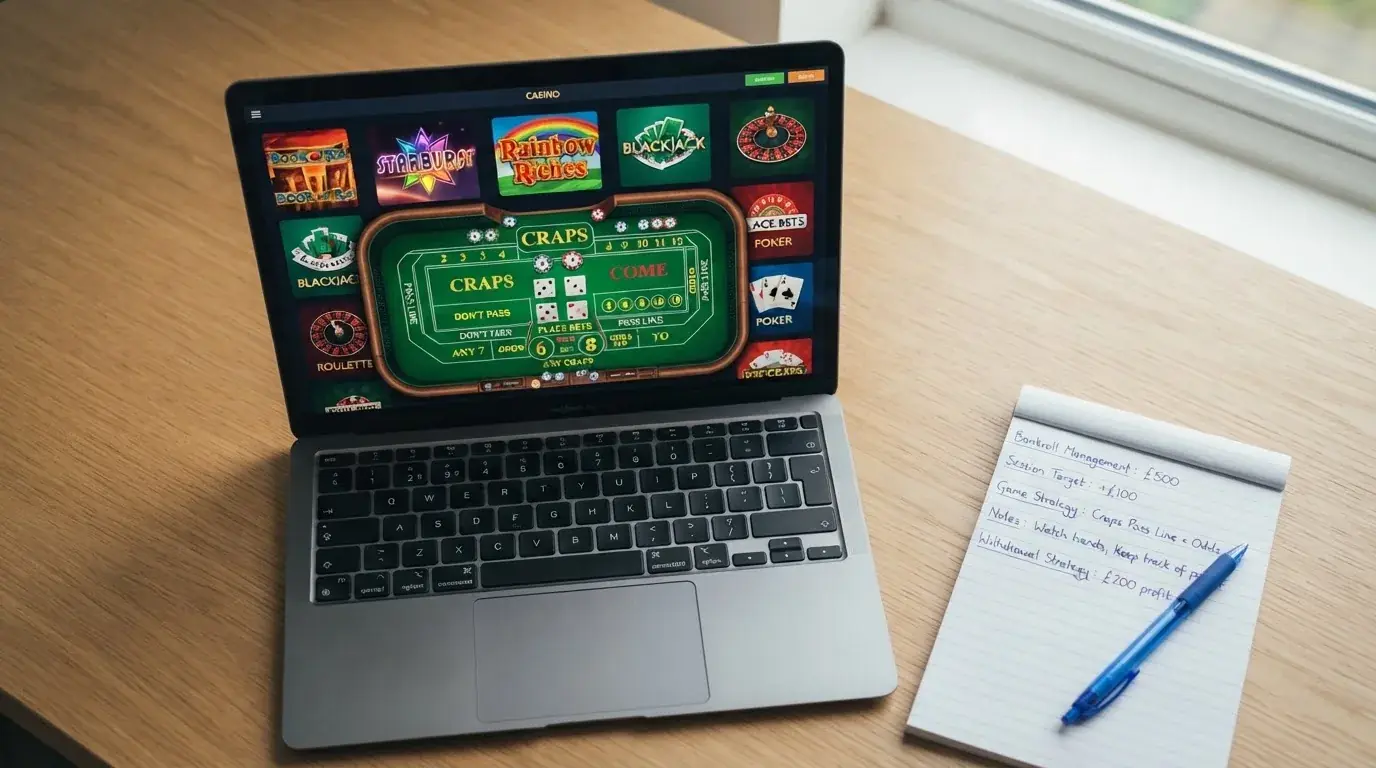
A UK player has two paths to a craps table at a licensed site. The first is a digital table — a video-game version of the layout with the dice resolved by a random number generator. The second is a live-dealer table, where a real stickman and a real pair of dice sit in a studio and the round is streamed to the player’s screen.
Live craps in the licensed UK market is dominated by Evolution, whose Live Craps product runs in a speakeasy-themed studio, includes a built-in interactive tutorial, and offers an “Easy Mode” aimed at first-time players. The round is split into a Come Out roll followed by a Point roll, with some bets resolved after a single throw and others spanning several throws. The studio product is what most UK-licensed craps tables look like; the digital product is rarer and tends to come from a smaller set of studios.
A few practical differences:
- Pace. Live craps runs at human speed — typically 30 to 60 seconds per wager, depending on how many players are at the table. Digital craps runs as fast as a player can click, which is both faster and lonelier.
- Bet verification. On a live table, a player’s chip placement is watched by the dealer; on a digital table, the bet is registered the instant it is placed and there is no second pair of eyes.
- Minimum stake. Live craps minimums at UK-licensed sites are typically higher than digital table minimums, often £1 to £5 on the live product and lower on the digital product.
- Game weighting under a bonus. Both formats are usually treated the same under a bonus terms table — table games weighted lower than slots, sometimes excluded.
For a player who has never played craps, the live product with its built-in tutorial is the easier entry point. For a player who knows the bets and wants speed, the digital product is the cheaper one to run.
Adjacent games: crash titles, baccarat and why they keep appearing in the same lobby
Craps is not the only game a UK-licensed craps player will see in a lobby. Two neighbouring products recur in the search results and the comparisons a player meets while they shop around.
The first is Aviator, a crash-style multiplayer game from Spribe, the studio that released it in 2019 and which describes it as the first true multiplayer crash game in the regulated iGaming space. The mechanic is simple: a multiplier rises from 1.00x, and a player must cash out before the round randomly crashes. Spribe reports more than 42 million active users and roughly 350,000 bets per minute across more than 5,000 operators worldwide. It is not craps. It is also the kind of product a player meets in the same breath as craps because both are dice-and-multiplier games pitched at a similar audience.
The second is baccarat, in its Punto Banco form, which is the most widespread baccarat variant globally. Punto Banco developed in Havana during the 1940s. The casino banks the game at all times, both hands are dealt out under fixed drawing rules, and the player makes no strategic decisions — they only choose which hand to back. Chemin de Fer, the most popular variant in France, gives players strategic choices and an element of skill that Punto Banco does not. Baccarat Banque is a three-player variant with limited and unlimited forms. None of these is craps. They are the games in the same room as craps at a UK-licensed casino, and a player weighing where to play will see them in the lobby.
Aviator is a multiplayer crash game; baccarat is a banker-dealt card game; craps is a dice game with a low-edge main bet. They share a casino floor but they are not substitutes for each other.
How the ten UK-licensed brands stack up on craps
This is not a ranking and not a recommendation. The brands below are ten active Gambling Commission licensees drawn from the public register, in the order research took them from the register. Several share a single licensee, which matters for how a player reads the table.
A note on shared licences: Ladbrokes and Paddy Power and Betfair do not all sit on different licences. Ladbrokes is held by LC International Limited. Paddy Power and Betfair are both held by PPB Games Limited. Virgin Games and Jackpotjoy are both held by Gamesys Operations Limited. A player comparing “ten operators” is in practice comparing fewer licensees, and that is the structural fact the table below makes explicit.
| Brand | Licence holder (GB remote casino licence) | Domain status | Subject support |
|---|---|---|---|
| Grosvenor Casinos | Rank Interactive (Gibraltar) Limited, 057924-R-334666-005 | Active | no-data |
| Betfred | Petfre (Gibraltar) Limited, 039544-R-319290-010 | Active | no-data |
| 32Red | Platinum Gaming Limited, 045322-R-324275-019 | Active | no-data |
| BetVictor | BV Gaming Limited, 039576-R-319370-028 | Active | no-data |
| William Hill | WHG (International) Limited, 039225-R-319373-015 | Active | no-data |
| Virgin Games | Gamesys Operations Limited, 038905-R-319430-022 | White label | no-data |
| Ladbrokes | LC International Limited, 054743-R-330863-014 | Active | no-data |
| Paddy Power | PPB Games Limited, 039411-R-319335-010 | Active | no-data |
| Betfair | PPB Games Limited, 039411-R-319335-010 | Active | no-data |
| Jackpotjoy | Gamesys Operations Limited, 038905-R-319430-022 | Active | no-data |
The empty right-hand column is the honest answer to the question a player most often asks: “Does this casino have craps?” The register does not record game-by-game availability; it records licences and domains. None of the ten is more likely than the others to carry craps on the evidence of the register alone. What changes between them is the operator’s history with Evolution’s live product, the depth of the table-games lobby, and the way the site handles craps weighting under a bonus — all of which live on the operator’s own platform rather than on the Commission’s register.
The shared licences matter. PPB Games runs Paddy Power and Betfair off the same remote licence, and the two sites share a lot more than a regulator’s entry — bonus structures, payment rails, safer-gambling tooling. A player choosing between them is choosing between two brands on the same engine, not two independent operators. The same is true of Gamesys Operations, which runs Virgin Games (under a white-label arrangement) and Jackpotjoy. Grosvenor, Betfred, 32Red, BetVictor and William Hill each sit on their own licence and are the genuinely distinct options.
For a UK player, the practical question is not “which is best” — the register does not carry that signal — but “which is a real, current, UK-licensed casino with a table-games lobby that includes craps”. The first half of that question is settled by the licence column above. The second is something the player has to check on the operator’s own platform, because the register does not list game inventory.
The wider UK casino landscape, and what the numbers look like
A wider read on the market helps frame the choice. The Gambling Commission’s public register listed 139 businesses holding an active remote casino operating licence on 18 September 2026.
| Market Metric | 2026 Register Data |
|---|---|
| Active remote casino licences | 139 |
| Active domains | 1,065 |
| White-label domains | 361 |
The licence number itself is informative. A remote casino licence number has the form account number-R-number-suffix, where the leading six digits repeat the licence holder’s account number and the “R” marks a remote (online) licence. Reading “057924-R-334666-005” tells a player this is licence account 57924, the fifth variation of remote licence 334666. The whole register is searchable online and downloadable in CSV and Excel form, so any player who wants to verify a brand before depositing can do so.
The legal frame that produces this register is the Gambling Act 2005 for Great Britain (England, Scotland and Wales — Northern Ireland is covered by separate legislation), tightened for online operators by the Gambling (Licensing and Advertising) Act 2014. Since 2014, any operator taking customers in Great Britain needs a Commission licence wherever it is based. A Curaçao, Maltese or Gibraltar licence is not a substitute. The licensee here is often a Gibraltar-registered company — Rank Interactive (Gibraltar) Limited, Petfre (Gibraltar) Limited, WHG (International) Limited — and that is fine: the licence they hold is a UK Gambling Commission remote casino operating licence, not a Gibraltar one.
Where the protected and the unprotected sites split
The cleanest single fact about the UK market is what a player gives up by going outside it. Providing gambling to people in Great Britain without a Commission licence is an offence under section 33 of the Gambling Act 2005. The Commission disrupts illegal sites through cease-and-desist notices, search-engine delisting and referrals to payment and hosting providers, but it does not have ISP-blocking power. The penalty does not fall on the player; what the player loses on an unlicensed site is the protected layer of the licensed market — no GAMSTOP, no Commission complaints route, no approved ADR.
A player who knowingly plays at an unlicensed site has decided the higher edge, the missing safer-gambling floor, and the absence of a complaints route are worth the trade. That is a real choice and a real market. It is also, for most players, the wrong trade, because the licensed market exists precisely to make the protected path the easier one. The 10x wagering cap, the £5/£2 slot stake limits, the GAMSTOP integration, the ADR — none of it is optional at a licensed site.
Players pay no tax on gambling winnings in the UK. Operators pay Remote Gaming Duty, which rises from 21% to 40% from 1 April 2026. The duty is on the operator, not the player, and it is the reason a UK-licensed site runs on tighter margins than an offshore competitor. A player who reads about the duty increase in the news should not conclude their own returns change; it is a tax on the house, not on the bet.
Reading a single operator — the questions that survive the comparison
Every operator write-up that follows is structured around four questions, and the questions survive the answer the register gives. They are: what licence does this brand sit on, what is the brand’s wider positioning in the UK market, where does craps sit in that positioning, and what is the verdict for a player choosing this brand for craps.
A licence line that says “the active remote casino operating licence held by X, account N” is the floor of the answer. The brand’s wider positioning is the part the register does not carry: a heritage bookmaker, a casino-first brand, a white-label partner. Craps availability is a question about the operator’s own platform, not the Commission’s register. The verdict is the page’s own judgement of whether this brand is the right pick for a craps player, given everything above.
Grosvenor Casinos — the UK high-street name with a casino-first lobby
Grosvenor Casinos sits on Gambling Commission remote casino operating licence 057924-R-334666-005, held by Rank Interactive (Gibraltar) Limited, with Grosvenor Casinos listed on the public register as an active domain. The brand is one of the more recognisable UK casino names on the high street, and its online product runs as a casino-first lobby rather than a sportsbook with a casino attached. For a player who comes to craps from a UK casino background rather than from a sportsbook, the brand’s positioning is the easiest fit on this list.
The craps question is a platform question rather than a register question. The brand’s table-games lobby is broader than most bookmakers’ casinos, and live craps on Evolution’s studio is the likely shape of any craps product the player finds there. A player who values a casino-first brand with a familiar UK name gets the licensed floor underneath them without giving up the lobby depth they might want at a craps table.
Verdict: this is a strong fit for a player seeking a UK-casino-first environment; ensure you verify craps availability directly on the platform before creating your account.
Betfred — the heritage bookmaker with a broad table lobby
Betfred operates on licence 039544-R-319290-010, held by Petfre (Gibraltar) Limited. As a prominent heritage bookmaker, the brand features a casino integrated within its sportsbook platform. The extensive table-games lobby includes Evolution’s full live suite, allowing sports-focused players to transition seamlessly to table action.
The licensed floor underneath Betfred is the same as every other operator on this page — GAMSTOP, the 10x wagering cap, the £5 slot stake for over-25s, the £2 cap for 18-24s, the financial vulnerability check at £150 net deposits in a rolling 30 days. What differs is the surface: a sportsbook-shaped site, with craps in the casino tab rather than on the front page. For a player who splits time between sports and casino, that is an asset. For a casino-only player, it is a small inefficiency.
Verdict: an excellent choice for a user who splits time between sports and casino on a single wallet; it is less obviously suited for a casino-only player.
32Red — the casino-only brand with a long-running live product
32Red sits on Gambling Commission remote casino operating licence 045322-R-324275-019, held by Platinum Gaming Limited. The brand is one of the longer-running UK casino-only names, and the site’s product is built around the casino rather than around a sportsbook. The live casino is the centre of the platform, and Evolution’s live craps studio is the most likely form a craps table takes here.
A casino-only player gets the licensed floor — GAMSTOP, the 10x cap, the same safer-gambling tooling as every other site — without the sportsbook overhead. The wagering clock on a craps-eligible bonus runs against the same 10x ceiling as anywhere else. The brand’s positioning is closer to Grosvenor’s than to the heritage bookmakers, but with a tighter casino focus.
Verdict: the optimal choice for a casino-only player wanting a long-standing UK brand with a live-dealer casino at its core; confirm game availability on the platform.
BetVictor — the heritage bookmaker with a casino built around live tables
BetVictor, under licence 039576-R-319370-028 held by BV Gaming Limited, operates as a heritage UK bookmaker where the casino experience is centred on live tables. This makes it a natural home for live craps compared to purely sportsbook-focused sites. The casino provides a straightforward entry point for players prioritising live-dealer games.
The licensed floor underneath is the standard one. The brand’s positioning is similar to Betfred’s on the sports side, but the casino side leans further into live tables. A player who has a sports account here and wants to play craps on the same wallet has a clearer path than at a sportsbook-shaped casino; a player who comes to craps without a sports background still has a casino-first product to land on.
Verdict: highly suitable for the sports-and-casino enthusiast; it also serves as a strong alternative for the casino-only craps player.
William Hill — the largest heritage bookmaker and the broadest casino floor
William Hill sits on Gambling Commission remote casino operating licence 039225-R-319373-015, held by WHG (International) Limited, with William Hill listed as an active domain. The brand is the largest of the heritage UK bookmakers and runs the broadest casino floor on this list. The live casino carries Evolution’s full studio, the table-games lobby is deeper than most bookmakers’, and a craps player finds the game in the same place they find the rest of the live product.
The licensed floor is the same one every operator on this page sits on, and William Hill’s scale means the safer-gambling tooling — GAMSTOP, financial vulnerability checks, the pre-deposit financial limit prompt — is more deeply integrated than at a smaller operator. That is a real asset for a player who values the protected layer of the licensed market. It is also a brand whose craps availability is a question about the platform, not the register.
Verdict: a solid option for the player who values a vast casino floor and deep safer-gambling integration; game presence should be verified on their platform.
Virgin Games — the white-label casino with a partner-brand feel
Virgin Games sits on Gambling Commission remote casino operating licence 038905-R-319430-022, held by Gamesys Operations Limited, with Virgin Games listed on the register as a white-label domain. A white-label site trades under another company’s licence, which is what makes Virgin Games interesting rather than weaker — the licence holder is the same Gamesys Operations that runs Jackpotjoy, and the protected floor is identical.
A white-label arrangement changes how a player reads the brand. Virgin Games is not its own licensee; it is a partner brand running on Gamesys Operations’ licence. That is normal and licensed, and the player gets the same safer-gambling tooling, the same 10x wagering cap and the same GAMSTOP integration as a directly-licensed brand. What changes is the question of where craps sits in the lobby, which is a Gamesys Operations platform question rather than a Virgin-specific question.
Verdict: a logical choice for the Virgin brand enthusiast who is comfortable on a partner-brand casino; check their platform for specific craps listings.
Ladbrokes — the heritage bookmaker with the largest UK high-street footprint
Ladbrokes, held by LC International Limited under licence 054743-R-330863-014, is a heritage UK bookmaker with a significant high-street presence. Its online casino is housed within the sportsbook site, featuring the full Evolution live suite. This operator is a familiar destination for high-street customers transitioning to online play.
Ladbrokes is the entry point on this list for the player who has used the high-street bookmaker before and wants the same brand online. The licensed floor is the standard one, and the brand’s scale means the safer-gambling tooling is integrated to the same depth as at William Hill. The craps question is a platform question rather than a register question.
Verdict: an appropriate pick for a heritage-bookmaker enthusiast seeking scale; confirm specific craps availability directly on their platform.
Paddy Power — the Irish-UK bookmaker with a punchy casino product
Paddy Power sits on Gambling Commission remote casino operating licence 039411-R-319335-010, held by PPB Games Limited, with Paddy Power listed as an active domain. The brand is a major UK-facing bookmaker with a strong marketing profile and a casino product that sits alongside the sportsbook. The licensed floor is the same one every other operator on this page sits on, and Paddy Power’s casino runs Evolution’s live studio.
A player picking Paddy Power over another brand on this list is picking the brand rather than the licence, since Paddy Power and Betfair share the same licensee. The two are not the same product — different sites, different bonus structures, different lobbies — but the regulatory floor and the safer-gambling tooling are identical. Craps availability is a platform question.
Verdict: a strong choice for the Paddy Power brand fan; it offers the same high-standard licensed floor as Betfair. Check the lobby for craps.
Betfair — the exchange-led brand with a casino built around it
Betfair operates on licence 039411-R-319335-010, held by PPB Games Limited. Best known for its betting exchange, the brand offers a casino section integrated alongside its exchange offerings. The live casino includes the complete Evolution suite, providing a polished experience for players who enjoy casino games alongside their exchange activity.
A player picking Betfair over Paddy Power is picking the exchange-shaped site over the sportsbook-shaped one. The licence is the same, the safer-gambling floor is the same, and the craps product is the same Evolution studio. What differs is the surface — an exchange-led site rather than a sportsbook-led one. For a player who comes to craps from an exchange background, that is the natural fit.
Verdict: an ideal fit for the exchange-oriented player who wants the casino experience as a side offering; shares the same licensed standards as Paddy Power.
Jackpotjoy — the bingo-led brand with a casino attached
Jackpotjoy, under licence 038905-R-319430-022 held by Gamesys Operations Limited, is primarily known as a bingo-focused brand. Its casino offering features table games as a secondary category. For craps players, this translates to a different lobby layout, distinct from casino-first platforms, which may appeal to those preferring a bingo-centric environment.
The licensed floor is the same one every other operator on this page sits on, and the platform is the same Gamesys Operations platform that runs Virgin Games under a white-label arrangement. A player picking Jackpotjoy over the casino-first brands is picking a different shape of lobby. The craps question is the same platform question as at Virgin Games.
Verdict: a fit for the player who wants a bingo-led casino with a table-games tab; craps availability is a platform question.
Craps and the UK casino market in 2026 — closing the loop
A UK player who wants to play craps online has, in 2026, a narrower choice than the search results suggest. The Gambling Commission’s register holds 139 active remote casino operating licences and over a thousand active domains, but craps is not a game every casino carries. The register does not record game inventory. What it records is who is licensed; what each licensed site actually runs is a platform question that the player has to answer on the operator’s own product.
The path through that question runs through four steps. The first is to pick a Gambling Commission licensee, which is what this list of ten brands does — each is a current, active, UK-licensed operator with a verified entry on the public register. The second is to confirm craps availability on the platform, because the register is silent on game inventory and the right answer varies. The third is to read the bonus terms if a welcome package is on the table, because the 10x wagering cap, the game weighting and the craps exclusion list are all in the small print and the small print varies between operators. The fourth is to set a financial limit before the first deposit, which is the rule the Commission requires of every licensee from 31 October 2025, and which a craps player benefits from as much as any other.
The wider market the page has sketched — Evolution’s live craps studio, the digital table product, the 10x bonus cap, the GAMSTOP integration, the £5/£2 slot stake limits for over-25s and 18-24s respectively, the financial vulnerability check at £150 net deposits, the no-tax-on-winnings regime — is the protected layer a UK licence buys. An offshore site offers higher edges, faster settlement and looser sign-up; it does not offer any of the above. The choice is not between craps at one site and craps at another; it is between craps inside the protected layer and craps outside it.
For most players, the right pick is a UK-licensed site with a live craps table they can reach on a phone or in a browser, a welcome package whose terms page mentions craps at a clear weighting under the 10x cap, and a financial limit set before the first deposit. The ten brands on this list all clear the first test. The second and third are platform questions, and the player answers them.
Frequently asked questions about online craps at UK casinos
How do craps payouts work at a licensed UK online casino?
Payouts in craps are paid against the bet, not the dice. The Pass Line pays 1:1 on a win, an Odds bet behind it pays at true mathematical odds (2:1 on a point of 4 or 10, 3:2 on 5 or 9, 6:5 on 6 or 8), and proposition bets in the centre of the table pay higher multiples on specific dice combinations. The Pass Line itself carries a 1.41% house edge; Odds bets behind it are 0%.
Is online craps available as a live-dealer game or only as a digital table?
Both formats are available at UK-licensed casinos. Evolution’s Live Craps runs in a speakeasy-themed studio with a built-in tutorial and an Easy Mode for first-time players. Digital craps runs as a video-game version of the layout with the dice resolved by a random number generator, with no dealer and no second pair of eyes on chip placement.
Can craps be played through a casino app on a phone?
Most UK-licensed craps play runs through a mobile browser rather than a dedicated craps app, because craps is a low-volume game for any single licensee. The brands on this list expose craps through the same HTML5 client that runs the rest of the lobby, on the same login, with Evolution’s Live Craps scaled to a portrait phone screen.
Do UK craps tables use the same bet types as a physical casino table?
The licensed UK craps product carries the same bet set as a physical casino craps table — Pass Line, Don’t Pass, Come, Don’t Come, Odds, Place bets on 4, 5, 6, 8, 9 and 10, and the proposition bets in the centre of the layout. The differences are in pace (digital is faster, live is human), minimum stake (live minimums are usually higher) and the absence of a stickman on a digital table.
What bonus terms usually apply when a bonus can be used on craps?
Three terms decide it: whether craps is in the eligible-games list, the game weighting (table games are commonly weighted at 10% to 20% of slots), and any max-cashout cap. The 10x wagering cap that took effect on 19 December 2025 sets the ceiling on the multiplier. A £100 bonus at 10x requires £1,000 of qualifying turnover before withdrawal.
Are craps tables offered by crypto-friendly casinos different from standard ones?
The craps table itself is not different. A UK-licensed casino that accepts crypto deposits runs the same Evolution live craps product as a casino that does not. What is different is the deposit path — crypto moves money faster than a card and without a card scheme’s footprint — and the verification step, which a UK-licensed site still requires before the first deposit regardless of the payment method. A crypto deposit at a UK-licensed site is not an anonymous deposit.
Published by the casinoprovidersuk team.