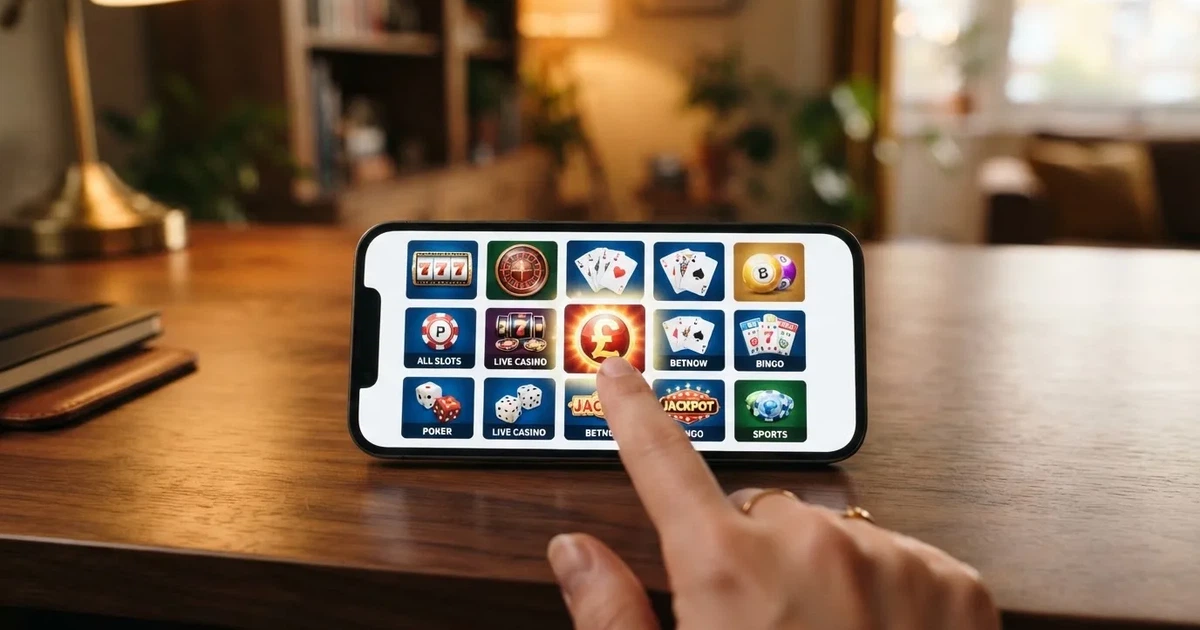
Best Android casinos UK: what a phone player actually needs from a licensed site
 Available in GB
The browser tab and the dedicated app both reach the same casino these days. What separates one Android experience from another is not the marketing line or the welcome offer headline, but the licence account underneath the brand, how the cashier behaves on a mid-range handset, and whether the slot stake limits in force since spring 2025 hit the budget a player walks in with. This page works through those questions across ten Gambling Commission-licensed brands and lays out the rules every one of them operates under.

Current as of 23 September 2026 · data cross-checked against the Gambling Commission’s public register of gambling businesses
Table of Contents
- Responsible gaming on Android
- Crypto and anonymity on Android
- Payments and payout speed on Android
- Welcome bonuses and wagering on Android
- Mobile and app experience on Android
- Ranking the top ten Android casinos in the UK
- The UK Android casino landscape in context
- How UK Android casino regulation shapes the experience
- Frequently asked questions about Android casinos in the UK
Responsible gaming on Android
The screen gets smaller, the controls get tighter, and the temptation to fire off another spin during a commute stays exactly the same. A UK-licensed Android casino has the same player-protection machinery behind it as the desktop site, and that machinery does not soften for mobile.

GAMSTOP has been a mandatory condition of every remote operating licence since 31 March 2020, so a player who has registered with the national self-exclusion scheme will be blocked at every brand reviewed here. The exclusion runs for six months, one year or five years, and it cannot be cancelled early once the period begins. The register sits in front of the deposit screen at sign-up, not behind a support ticket.
The deposit-limit regime arrived in stages. From 31 October 2025 every licensed operator must prompt a customer to set a financial limit before the first deposit is accepted. There is no state-set ceiling written into the rules, so the figure a player lands on is theirs to choose, but the operator is obliged to surface the question. A finer-grained check runs from 28 February 2025: once net deposits cross £150 in a rolling 30-day window, a financial vulnerability check fires using public data, designed to flag patterns associated with gambling harm without dragging in a credit search.
The harder edges sit on the slots themselves. From 9 April 2025 a single spin on an online slot may not exceed £5 for players aged 25 and over; from 21 May 2025 the cap for 18-to-24-year-olds is £2 per game cycle. Auto-play has been banned since 31 October 2021, a spin may not complete faster than 2.5 seconds, and any visual presentation of a spin as a win when the spin in fact lost money is prohibited. The spin-time floor matters as much on a touchscreen as it does at a desktop, because it sets the cadence the player is forced into whether they tap or click.
Help is one tap away regardless of brand. GamCare runs the National Gambling Helpline, GambleAware funds treatment and education, and every operator reviewed here offers its own self-exclusion and time-out tools alongside the GAMSTOP route. The phone does not move any of these protections out of reach.
Crypto and anonymity on Android
A phone is a natural fit for crypto payments, because the wallet, the exchange app and the casino tab all sit on the same device. That does not make crypto a clean route into a UK-regulated Android casino, and the confusion is worth clearing before any reader assumes otherwise.

Every brand in this guide operates under a Gambling Commission remote casino operating licence. The Commission’s identity-verification regime has been in force since 7 May 2019: name, address and date of birth are checked before the first deposit or any play. That check runs on the Android client exactly as it does on the desktop, and there is no anonymous tier. Bitcoin, Ethereum or any other token deposited into a licensed operator is still subject to the same source-of-funds review as a debit-card top-up, and the cashier will ask the same questions either way.
What the phone does change is the friction. Apple Pay runs natively on the handset through near-field communication, but Apple Pay is not in the licensed cashier set for crypto-funded deposits; it fronts a card, not a wallet address. AstroPay sits closer to the crypto rails, having spun off the payment-processing business dLocal in 2016 and operating in the UK through Larstal Limited, an electronic money institution authorised by the Financial Conduct Authority under the Electronic Money Regulations 2011, with parallel licences on the Isle of Man, in Brazil and in Denmark. Even on that route, the Gambling Commission’s verification still applies at the casino end.
The closer a reader gets to “no KYC, deposit in BTC, play” the further they travel from the Commission register and the protections that come with it. Section 33 of the Gambling Act 2005 makes it an offence to provide gambling to people in Great Britain without a Commission licence, and the Commission disrupts unlicensed sites through cease-and-desist notices, payment referrals and search-engine delisting, but has no ISP-blocking power. A player who lands on an offshore site forfeits GAMSTOP, the Commission complaints route and any approved alternative dispute resolution. The wagering cap introduced on 19 December 2025 — a 10x ceiling on bonus wagering and a ban on mixed-product offers — does not exist on an unlicensed site either, so the headline “no rules” is genuinely the case, and so is the absence of any complaint channel when something goes wrong.
For a UK Android player, the realistic payment picture is debit card, bank transfer through the Faster Payments Service, Apple Pay, AstroPay and the licensed operator’s own e-wallets, with KYC intact. Crypto deposits exist at offshore brands, but the package they belong to is not the one this page covers.
Payments and payout speed on Android
The Faster Payments Service runs 24 hours a day, seven days a week, and most transfers arrive instantly or within a couple of minutes, with an outside bound of two hours. Pay.UK operates the scheme, which carries a £1,000,000 per-transaction limit, though banks routinely impose lower customer-level limits. The Bank of England oversees safety and provides final settlement without being a direct participant.
What that means on a phone is that withdrawals to a UK bank account can be set up in the cashier, confirmed with Face ID or a fingerprint, and arrive while the player is still on the bus.
| Method | Processing time | Authentication |
|---|---|---|
| Debit card | Instant to 2 hours | Card detail |
| Bank transfer | Instant to 2 hours | Bank approval |
| Apple Pay | Instant to 2 hours | Face ID / Touch ID |
Credit cards were banned for gambling on 14 April 2020, including credit-card funding routed through e-wallets; debit cards and bank transfers were never caught by the ban. The Commission’s 2018 survey estimated that around 800,000 UK consumers used credit cards to gamble, and found that 22 per cent of online gamblers who used credit cards to gamble were classed as problem gamblers, which framed the policy decision. An Android player without a debit card will find the licensed cashier narrower than they expected, because no credit-card route exists at any of the brands reviewed here.
What speeds up a withdrawal is not the brand’s marketing slogan but the verification state of the account. The first withdrawal typically triggers the source-of-funds review the registration did not, and that adds hours or days depending on what the player uploads. Subsequent withdrawals, with KYC already on file, run on the payment rails above: instant to a couple of hours for Faster Payments, near-instant for Apple Pay where the operator supports it.
Welcome bonuses and wagering on Android
The bonus market on UK-licensed sites has been redrawn by the rules that took effect on 19 December 2025: wagering requirements capped at 10x the bonus amount, and mixed-product bonuses — the kind that hand out casino free spins after a sports bet — banned outright. These are not optional, and they apply equally to the Android client and the desktop.
A 10x cap sounds generous until the multiplication is done. A £100 welcome bonus carries a £1,000 turnover obligation before any of it converts to withdrawable cash. At a £5 maximum spin — the cap for a player aged 25 or over — that is 200 spins, at 2.5 seconds each, around eight and a half minutes of continuous play, and a single spin at the £5 ceiling for an 18-to-24-year-old is forbidden. The arithmetic belongs to the player, not the welcome page: the offer is what it costs, and what it costs is the turnover that has to clear before the cashout button unlocks.
The Commission has not capped the bonus amount itself, so headline figures vary widely. What the rules do tighten is the language operators can use. “Free” spins with attached wagering conditions are no longer free in the everyday sense, and the requirement to display the wagering multiple prominently was already in force before the December 2025 ceiling. A reader who sees a welcome offer advertised on the Android splash screen should expect the same terms page on the desktop site; the screen size changes, the small print does not.
A worked band at the 10x ceiling makes the trade-off visible. For a £25 bonus the turnover is £250, which clears at 50 spins of £5 apiece and runs roughly two minutes and five seconds at the 2.5-second floor. For a £200 bonus the turnover is £2,000, clearing at 400 spins and around seventeen minutes at the same cadence. The same rules sit on either side of that band; what changes is the time the player spends inside the wagering window.
The pattern across this market is that the offers at the lower end of the band are common, and the heavy offers at the top end are rare, because the 10x ceiling makes large bonuses expensive to clear for the player and harder to justify for the operator. A reader comparing two Android casinos should weight the bonus size against the turnover and against the 2.5-second floor, and the right comparison is not “which is bigger” but “which clears faster at the stake limit that applies to me”.
Mobile and app experience on Android
Touchscreen handling separates a competent Android casino from one that simply ports a desktop layout into a smaller viewport. The browser version of a site does not require a download: every brand in this guide renders its lobby through Chrome, Firefox or any other modern Android browser. The dedicated app, where one exists, sits in the Google Play Store, and the Play Store review process is not a regulatory stand-in for a Commission licence.
Load time matters on a mid-range handset because the lobby is the first impression. Heavier graphics engines stutter on older devices, and a slot that takes six seconds to load on a flagship phone can take twice that on a budget handset. The brands that have invested in lighter lobbies — single-page lobbies, minimal JavaScript, progressive image loading — show up faster and feel less like a desktop site squeezed into a phone.
App stability is its own question. Crashes mid-session are expensive in the player’s time and in their bankroll if a spin was in flight when the app dropped, because the slot’s state is server-side, so a reconnect resolves the spin in the same place but the time spent reconnecting is gone. The 2.5-second spin floor keeps the cadence slow enough that this is rarer than it would be on a faster game cycle, but it does not eliminate it.
The real ergonomic test is what happens during a session of fifty spins. Tap targets have to be large enough to hit reliably, the spin button has to sit where a thumb can find it without looking, and the cashier has to be no more than two taps from the lobby. The brands that fail this test are not the ones that lack an app — some of the better Android experiences run entirely in the browser — but the ones that bury the cashier under a hamburger menu and hide the responsible-gaming tools three taps deep.
For a player who values speed of access, an app shortcut on the home screen can shave a second off each session. For a player who values storage space, the browser tab is fine. The licence and the responsible-gaming regime do not differ between the two paths.
Ranking the top ten Android casinos in the UK
The comparison below ranks ten brands by the criteria that matter on a phone, drawing on the Gambling Commission’s public register as it stood on 18 September 2026, when the register listed 139 businesses holding an active remote casino operating licence and held 1065 active domain entries alongside 361 white-label entries. A white-label domain trades under another company’s licence, so brands that share a licence account are not independent operators in the regulatory sense.
| Brand | Licence holder | GB remote casino licence | Domain status | Crypto support |
|---|---|---|---|---|
| Betfred | Petfre (Gibraltar) Limited | 039544-R-319290-010 | Active | — |
| Jackpotjoy | Gamesys Operations Limited | 038905-R-319430-022 | Active | — |
| William Hill | WHG (International) Limited | 039225-R-319373-015 | Active | — |
| kwiff | Eaton Gate Gaming Limited | 044448-R-323408-017 | Active | — |
| PokerStars | Stars Interactive Limited | 039108-R-319334-026 | Active | — |
| Ladbrokes | LC International Limited | 054743-R-330863-014 | Active | — |
| Paddy Power | PPB Games Limited | 039411-R-319335-010 | Active | — |
| Unibet | Platinum Gaming Limited | 045322-R-324275-019 | Active | — |
| Virgin Games | Gamesys Operations Limited | 038905-R-319430-022 | White label | — |
| Casumo | Recro Limited | 061549-R-336718-002 | Active | — |
Jackpotjoy and Virgin Games sit on the same licence account — Gamesys Operations Limited — which means Virgin Games is a white-label of that account rather than a separately regulated operator. The same is true of Ladbrokes, which sits under LC International Limited; Coral and Gala Bingo are on the same account, though neither is in the ranked set above. A reader comparing these brands should treat them as variations on the same underlying licence, not as ten independent licence holders.
What the table does not say, and what the rest of this page covers, is how each brand handles the Android experience. The licence is the floor; the rest is execution.
Betfred — the high-street name on a phone
Betfred’s Android client carries the same brand weight as its shop estate. The licence sits with Petfre (Gibraltar) Limited under account 39544, with Betfred.com listed as an active domain on the public register. What the phone adds is access to the same sportsbook and casino lobby that the desktop site runs, with the cashier structured around debit cards, bank transfer and Apple Pay. The verification regime that runs from 7 May 2019 applies on the Android client exactly as on any other device, and the £5 spin cap for over-25s and £2 cap for 18-to-24s are enforced at the slot level. For a player who already has a Betfred shop relationship, the phone is the continuation of that account rather than a separate product.
Jackpotjoy — the bingo-rooted lobby
Jackpotjoy grew out of the bingo market and the lobby reflects that lineage, with bingo rooms sitting alongside slots and a handful of table games. The licence is held by Gamesys Operations Limited under account 38905, with Jackpotjoy.com listed as an active domain. On a phone the bingo rooms translate well, because the chat and ticket-buying interfaces are built for smaller screens from the start. The casino side is competent rather than industry-leading, but the wagering cap that took effect on 19 December 2025 applies in full, and the welcome offer sits under that ceiling.
William Hill — another high-street brand under one licence
William Hill runs the same dual-track offering on Android as on desktop: sportsbook, casino, live dealer. The licence sits with WHG (International) Limited under account 39225, with William Hill listed as an active domain. The brand recognition buys nothing on the regulatory side, because every brand reviewed here is bound by the same Commission conditions, but it does mean the cashier and the responsible-gaming tooling are mature. The 2.5-second spin floor is enforced at the game level, not by the operator’s app, so the same cadence applies whether the player is on a William Hill slot or any other Commission-licensed slot.
kwiff — the smaller-brand experience
kwiff is a smaller brand on the Commission’s register, held by Eaton Gate Gaming Limited under account 44448, with Kwiff.com listed as an active domain. The Android client is the brand’s main product rather than a side offering, and the lobby is built around the casino experience rather than a sportsbook add-on. For a player who wants a phone-first product without the legacy of a high-street estate, kwiff is the closer fit. The licence conditions are identical to every other brand on the register, and the wagering cap and spin limits apply in full.
PokerStars — the poker-rooted Android client
PokerStars is the only brand in the ranked set that runs primarily as a poker product, with casino slots sitting alongside the poker lobby. Stars Interactive Limited holds the licence under account 39108, and Pokerstars.uk is listed as an active domain on the register. On a phone the poker table layout translates well, and the casino slots inherit the same account infrastructure. The welcome offer is structured around the casino product rather than the poker room, and the 10x wagering cap applies. A player whose primary interest is slots will find the casino lobby narrower than at a casino-first brand, but the Android polish is high.
Ladbrokes — the other LC International brand
Ladbrokes sits alongside Coral and Gala Bingo under LC International Limited, account 54743, with the remote casino operating licence 054743-R-330863-014. Ladbrokes is listed as an active domain. The Android client follows the same template as the desktop site, with a sportsbook that takes up most of the lobby and a casino tab behind it. For a player who came to Ladbrokes for the sportsbook and wants the casino to be available without leaving the app, the Android client delivers. The casino-only player has better-fit options elsewhere in the ranked set.
Paddy Power — the same LC-adjacent playbook
Paddy Power is held by PPB Games Limited under account 39411, with Paddy Power listed as an active domain. The Android client pairs the sportsbook with a casino product in the same way as Ladbrokes, but with Paddy Power’s brand voice in the promotional layer. The regulatory floor is identical, because the licence conditions are the same for every Commission-licensed operator. What differs is the marketing layer, and a player who responds to that voice will find it intact on the phone.
Unibet — the Nordic-rooted multi-product brand
Unibet is held by Platinum Gaming Limited under account 45322, with unibet.co.uk listed as an active domain on the register. The .co.uk domain is the UK-facing site rather than the .com, and the licence is held by the UK entity rather than the parent. The Android client covers sportsbook, casino and live dealer in a single app, and the casino lobby is deeper than at the sportsbook-first brands. For a player who wants one app for everything, Unibet is a closer fit than the brands where the casino sits behind the sportsbook.
Virgin Games — the white-label route into Gamesys
Virgin Games sits on the same licence account as Jackpotjoy, with Gamesys Operations Limited as the licence holder and Virgin Games listed as a white-label domain rather than an active one. The brand carries the Virgin name without the Virgin organisation sitting behind the licence, which is the standard structure for a white-label deal. On a phone the experience is close to Jackpotjoy’s, because the underlying platform is the same, with the Virgin brand layered on top. The regulatory protections are identical, because the licence account is the same.
Casumo — the casino-first Android product
Casumo is the casino-first brand in the ranked set, held by Recro Limited under account 61549, with Casumo listed as an active domain. The Android client is built around the casino lobby, with no sportsbook to compete for screen space. The brand’s adventure-style progression system translates well to a phone, and the cashier is structured around the casino deposit pattern rather than a sportsbook-first flow. The wagering cap and spin limits apply in full, and the welcome offer sits under the 10x ceiling.
The UK Android casino landscape in context
A thousand-plus active domains sit on the Commission’s register, and the ranked set above is a fraction of that. What the register proves is that the brand a player sees on their phone is one of a much larger licensed population, and the comparison between brands is therefore between brands, not between a brand and the unregulated alternative. The unlicensed alternative is a separate world with no GAMSTOP, no Commission complaints route and no approved ADR, and the section 33 offence under the Gambling Act 2005 sits on the operator, not the player.
The number of active remote casino operating licences — 139 businesses as of 18 September 2026 — is the floor of the licensed market. The 1065 active domains and 361 white-label entries sit on top of those 139 accounts, which means the average licence account runs multiple brands or multiple domains. A player reading a brand name on their phone is not necessarily reading the name of the licence holder, and the white-label structure means a brand can disappear and reappear under a different trading name without the underlying licence changing.
The broader market context is the Remote Gaming Duty rise from 21 per cent to 40 per cent from 1 April 2026, a model rather than a confirmation, and the wagering cap that took effect on 19 December 2025 at 10x. Both are operator-side changes, and neither changes the player’s tax position: UK players pay no tax on gambling winnings, and the duty sits on the operator’s gross profit. A player who sees a brand pass on the duty rise through tighter bonus terms or higher minimum deposits is reading the market correctly.
How UK Android casino regulation shapes the experience
The Gambling Act 2005 covers Great Britain — England, Scotland and Wales — and not Northern Ireland, where the regulation sits with the Irish Department of Communities. Since the Gambling (Licensing and Advertising) Act 2014 any operator taking customers in Great Britain needs a Commission licence wherever it is based, which means a Curaçao, Maltese or Gibraltar licence alone is not enough to take a UK deposit on an Android client. The licence account on the Commission’s register is the test, and the domain list shows which websites sit on which accounts.
The age-verification regime that has been in force since 7 May 2019 runs on every device, and the minimum age of 18 is enforced before the first deposit or any play. A player who cannot pass the verification step will not reach the lobby, regardless of how complete the Android client is. This is the single biggest difference between a Commission-licensed brand and an offshore one, because the offshore alternative does not run this check at all.
The slot stake limits — £5 for over-25s from 9 April 2025 and £2 for 18-to-24s from 21 May 2025 — are enforced at the game level, not by the operator’s app. A player who tries to spin above the cap will see the stake button refuse the input, regardless of which brand they are on. The 2.5-second spin floor, the auto-play ban and the ban on losses disguised as wins are also enforced at the game level.
The LCCP — the Licence Conditions and Codes of Practice — sets the social responsibility code that every operator follows, including the GAMSTOP integration and the deposit-limit prompt. The Remote Technical Standards set the technical bar, including the game-cycle rules above. A reader who wants the source documents can find them on the Commission’s site; this page is the working summary.
The dispute resolution path runs through the operator first, then through an approved ADR if the operator’s response is not satisfactory, and finally through the Commission itself for licence-condition breaches. A player who has used an unlicensed site has none of these routes, because the operator is not on the Commission’s register and therefore not subject to the LCCP or the ADR requirement. This is the structural reason an unlicensed site looks different from a licensed one, beyond the marketing.
Frequently asked questions about Android casinos in the UK
Do I need to download an app to play at an Android casino?
No. Every Commission-licensed brand in the ranked set renders its full lobby through a mobile browser, with no download required. The browser version uses the same account, the same cashier and the same responsible-gaming tooling as the app, and the game-cycle rules — the 2.5-second spin floor, the £5 or £2 stake cap depending on age — apply identically. An app adds convenience rather than capability, and a player who prefers not to use storage space for casino apps loses nothing functional by staying in the browser.
Can I deposit with cryptocurrency on an Android casino?
Not at any Commission-licensed brand. The identity-verification regime that has been in force since 7 May 2019 requires name, address and date of birth to be checked before the first deposit or any play, and that check runs regardless of the deposit method. Crypto-funded deposits are available at offshore brands that do not hold a Commission licence, but those brands sit outside the GAMSTOP and ADR framework. The Android client does not change that picture: the licence follows the operator, not the device.
How quickly do withdrawals process on an Android casino?
Withdrawals to a UK bank account run on the Faster Payments Service, which Pay.UK operates 24 hours a day, seven days a week, with most transfers arriving instantly or within a couple of minutes and an outside bound of two hours. The first withdrawal typically triggers a source-of-funds review that adds hours or days, and subsequent withdrawals run on the payment rails without that delay. Apple Pay withdrawals, where supported, clear in the same window with tokenised card data replacing the actual card number.
Do Android casinos offer the same welcome bonuses as the desktop site?
Yes. The welcome offer is tied to the player account, not the device, and the terms — including the 10x wagering cap that took effect on 19 December 2025 — apply identically. A player who claims a bonus on the Android client and then signs in on the desktop sees the same bonus balance and the same wagering progress, because the wagering state is server-side. Mixed-product bonuses are banned, so a sportsbook bet will not generate casino free spins regardless of the device.
How responsive are touchscreen controls on an Android casino site?
It depends on the brand’s lobby weight and on the handset. Lightweight single-page lobbies load faster and respond better on mid-range Android devices than heavy JavaScript engines, and tap targets sized for thumbs make a session of fifty spins manageable without mis-taps. The 2.5-second spin floor caps how fast any tap can resolve, so the worst-case lag is bounded by the game cycle itself. A dedicated app can shave a second off each session compared with a browser tab, but the underlying controls are the same.
Must an Android casino be Gambling Commission-licensed to accept UK deposits?
Yes. The Gambling (Licensing and Advertising) Act 2014 requires any operator taking customers in Great Britain to hold a Commission licence, and providing gambling to people in Great Britain without a licence is an offence under section 33 of the Gambling Act 2005. A Curaçao, Maltese or Gibraltar licence is not a substitute. The Commission’s public register is the test, and the domain list shows which websites sit on which licence accounts. An Android client does not change that requirement: the device is irrelevant to the licence question.
Prepared by the casinoprovidersuk editorial staff.